By Sarah Francescutti
Seeing Ourselves: Part of an ongoing series celebrating meaningful representation in children’s media and toys.
Recently, something quietly powerful happened in children’s television.
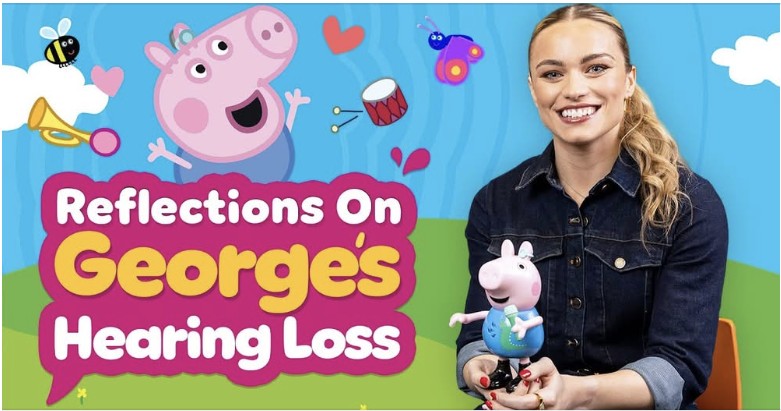
In a brand new storyline from Peppa Pig, George (Peppa’s little brother) is revealed to have a moderate hearing difference in one ear and will be fitted with a hearing aid. Two new episodes aired from March, beginning with the premier episode, ‘Hearing Test’, featuring deaf rugby star Jodie Ounsley, who provides the voice for the audiologist.
This moment is practical, calm, and normalized. George continues to be the same curious, muddy-puddle-loving little dinosaur fan he’s always been, and thousands of children across the UK who have moderate or unilateral hearing differences can see themselves reflected on screen.
The UK National Deaf Children’s Society worked with Hasbro throughout the development of this storyline to bring childhood deafness into the Peppa Pig world. George Crockford, CEO at NDCS, says, “Introducing this in a series as beloved as Peppa Pig is an important step toward creating a world where anything is possible for deaf children – a world where differences are celebrated and every deaf child feels seen, valued and included.”
Watch a discussion on the and representation: YouTube: Peppa Pig, George, and hearing difference representation
- See post from UK org: https://www.facebook.com/share/1CHGAznay8/
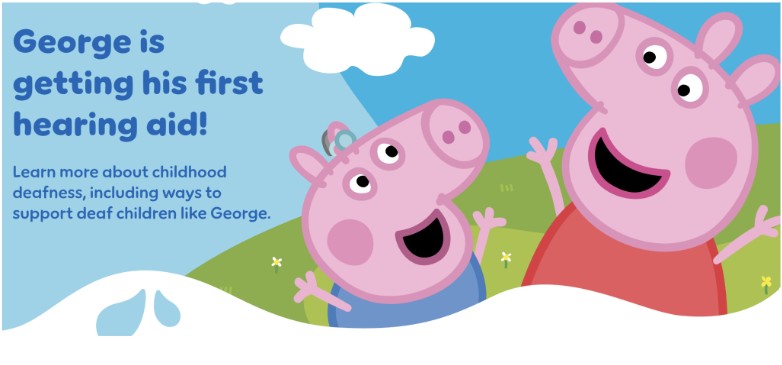
Learn more and explore resources with Peppa Pig characters: George Gets His First Hearing Aid
- Take a look at what happened when Jodie and George met deaf students and got a sneak peek at the episodes. https://youtu.be/OsgnNIDgsKQ?si=nHaRlx__V1R1TA27
- For more information, head over to the UK National Deaf Children’s website for more details. https://go.ndcs.org.uk/georgepiglaunchfb
Why This Kind of Representation Matters
Children’s programming plays a powerful role in how kids make sense of the world. Long before formal conversations about inclusion or accessibility, kids are learning from the stories they watch.
When a hearing difference is represented as:
- something that can be identified early
- something that comes with support and tools
- and something that doesn’t change who a child is
…it sends an important message to all children.
For children who are Deaf or Hard of Hearing (dhh), it offers recognition and affirmation. For hearing children, it builds understanding, empathy, and normalizes difference — without needing a “lesson.”
Hearing Differences by the Numbers
The Peppa Pig storyline reminds us that there are thousands of DHH children in the UK (number cited by the UK National Deaf Children’s Society) and hundreds of children in British Columbia, where about 1 in every 400-500 babies is born with permanent hearing difference. At any given time, this means hundreds of young children in BC are Deaf or hard of hearing.
This context highlights why representation like George’s story is so important and why it’s worth celebrating. It’s a small moment on screen with a global significance for children who see themselves reflected.
Not a “Special Episode” – Just Part of Life
What stands out most about this Peppa Pig storyline is what it doesn’t do.
It doesn’t isolate George’s hearing difference as a problem to be fixed. It doesn’t turn the episode into a dramatic arc. It doesn’t position hearing aids as something to be hidden or overcome.
Instead, it treats a hearing difference as one part of George’s experience — supported by caring adults and practical solutions.
This kind of representation helps remove stigma before it has a chance to take root.
Supporting Voices Behind the Scenes
Advocacy and education organizations, including the UK National Deaf Children’s Society, have highlighted this storyline as a positive step forward in representation. Conversations around the episode have focused on how early, accurate portrayals of hearing journeys can help families feel seen — and help children understand their own experiences.
Representation Builds Belonging
Representation doesn’t have to be loud to be meaningful.
Sometimes it looks like a familiar cartoon character going for a hearing test. Sometimes it looks like a child wearing hearing aids — and still being fully, joyfully themselves.
We’re encouraged to see children’s media taking these steps, and we look forward to highlighting more examples where kids of all abilities can see themselves reflected with care and respect.
Share What You’re Seeing
We know these moments are showing up in more places — on screens, in classrooms, and in everyday life.
If you’ve come across examples of thoughtful representation in children’s shows, movies, books, toys or public spaces, we’d love to hear about them.
Please send your examples to info@bchandsandvoices.com, and we may highlight them in a future “Seeing Ourselves” feature.
