The Value of Connecting-ਪੰਜਾਬੀ
Original article in English- https://www.bchandsandvoices.com/post/the-value-of-connecting/
The Value of Connecting-ਪੰਜਾਬੀ
Original article in English- https://www.bchandsandvoices.com/post/the-value-of-connecting/
Controlling the Narrative-ਪੰਜਾਬੀ
Original article in English – https://www.bchandsandvoices.com/post/controlling-the-narrative/
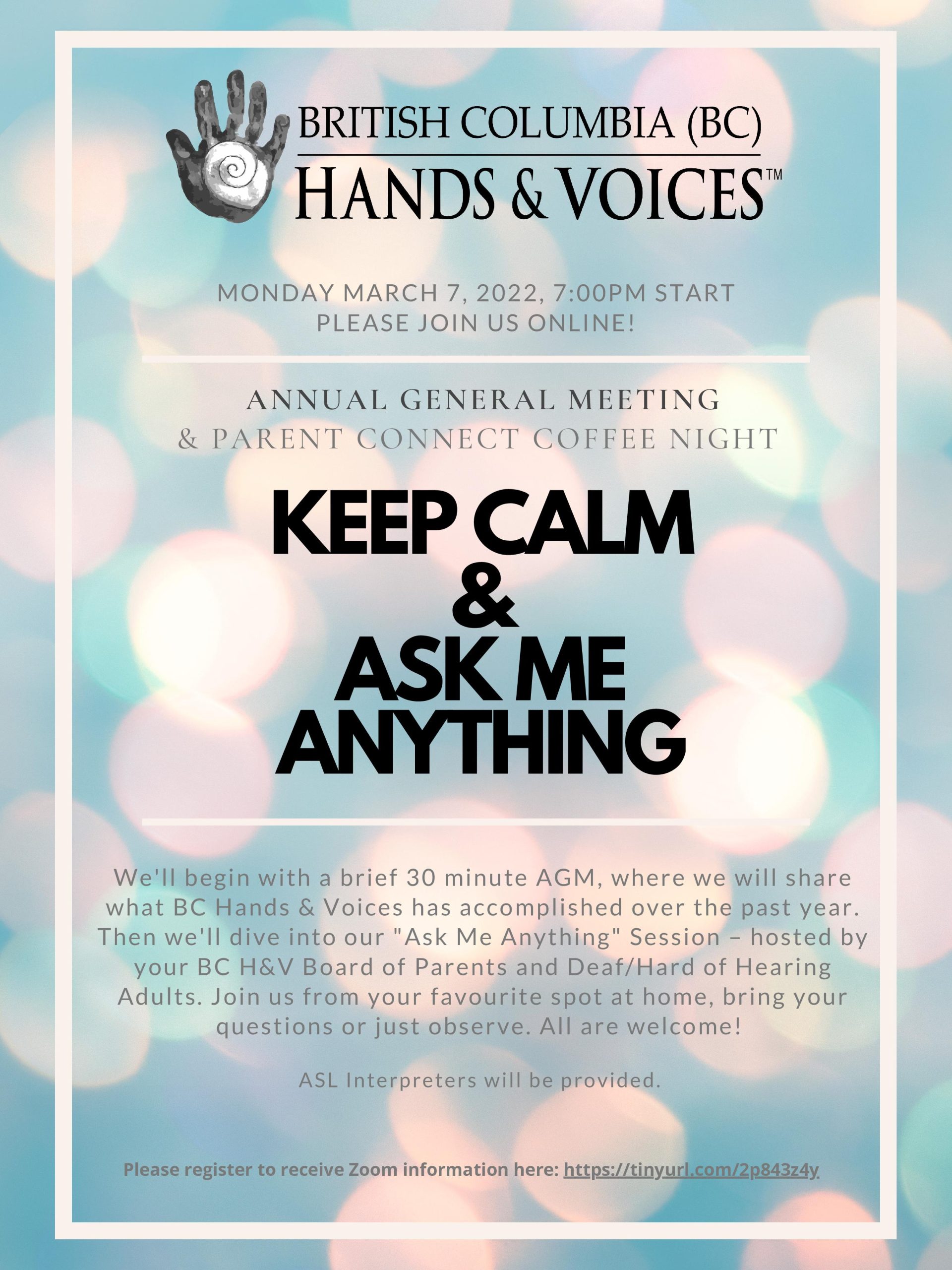
We’ll begin with a brief 30 minute AGM, where we will share what BC Hands & Voices has accomplished over the past year. Then we’ll dive into our “Ask Me Anything” Session – hosted by your BC H&V Board of Parents and Deaf/Hard of Hearing Adults. Join us from your favourite spot at home, bring your questions or just observe. All are welcome!
ASL Interpreters will be provided.
Please register to receive Zoom information here: https://tinyurl.com/2p843z4y
Download our flyer here: BCHV AGM 2022
By Levi Traxler
I am the kind of person who takes care of and does things at the last minute, sometimes at the absolute last minute. I’m even writing this article right before the deadline! It’s difficult for me to plan far ahead with so many things I need to take care of every day. Despite my constant struggle with being able to plan ahead better, I have learned how to become more proactive when it comes to accessing information. How? There have been plenty of events in my life that forced me to become more proactive if I wanted to understand what’s going on (and that is all the time!).
One example was when a hearing friend invited me to go watch a movie at a cinema. At the time, I knew the cinema didn’t have the Rear Window Captioning System or Open Captioned but I still chose to go because I really wanted to watch the movie and to be a part of my hearing friend’s group. They didn’t know ASL, only fingerspelling, so the conversations dragged on and misunderstanding happened often. I tried my best to watch the movie through lip-reading and using my hearing aids. It was not enough though, and I could only understand about ten percent of the movie. Money and time wasted for something that I knew would happen in the first place.
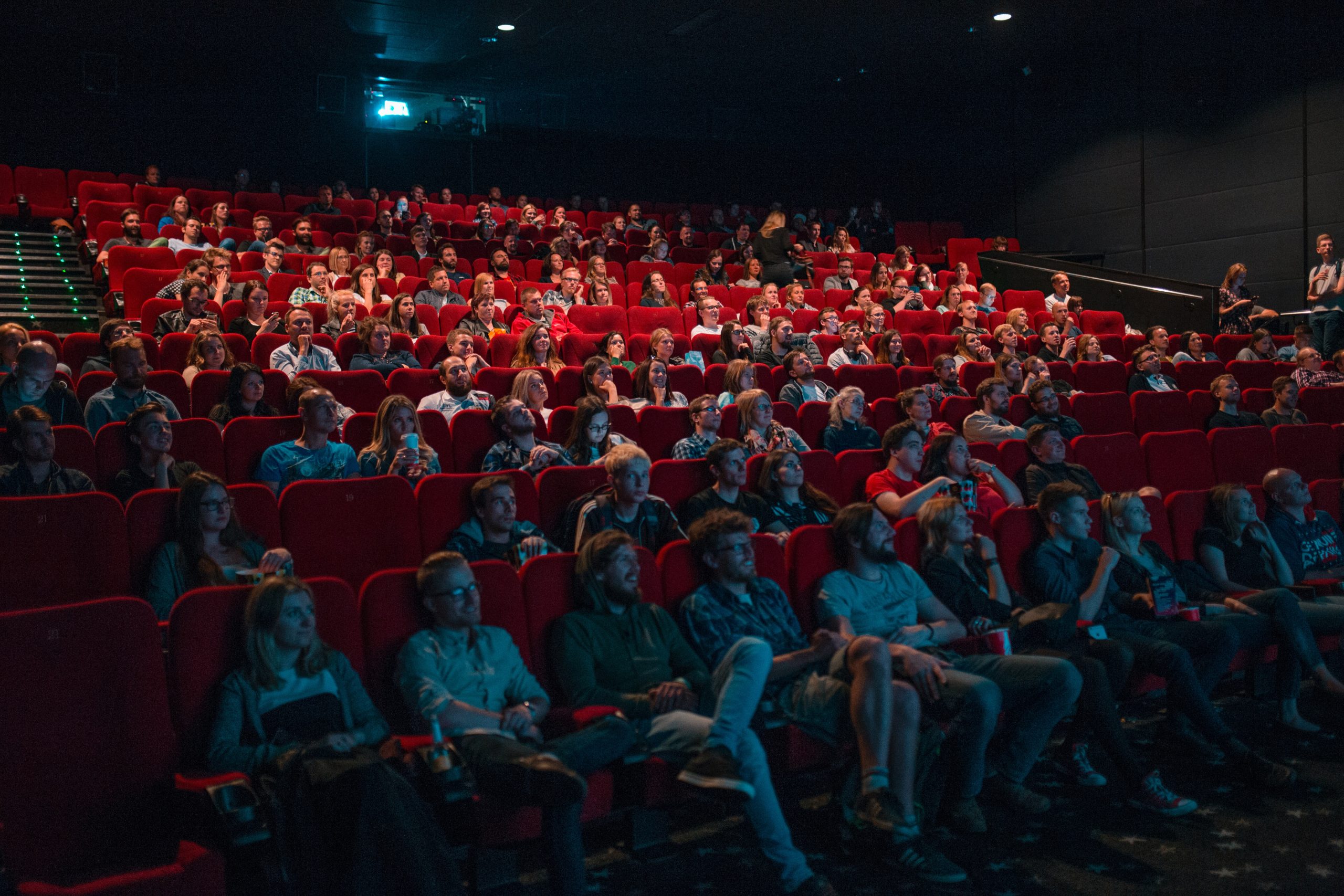
Photo credit: https://unsplash.com/@kristsll
That cinema experience forced me to start planning ahead to ensure that I have better access to information by researching which cinemas offer the captioning. I can pick that cinema the next time we decide to watch a movie. Nowadays almost all cinemas offer captioning for their movies, which is excellent. I am able to feel more comfortable going to the cinemas knowing I can enjoy the movies more.
Another example is when I’m ordering and waiting for food at a fast food location. Recently, I ordered a hotdog at Costco after a shopping spree. Costco, in the middle of the Covid-19 pandemic, is not accepting in-person orders so they are offering self-serving kiosks. I ordered my food at a kiosk and then waited for my order near the fast-food bar. We all had masks on, making it impossible for me to lip-read or rely on facial expressions to get an idea of the situation. A worker called my number to ask a question about the order, but I didn’t know at the moment and I noticed someone next to me was staring at me. Only then did I realize what had happened, so I walked over to the food court bar.
After that experience I became more proactive by showing the worker my order number and asking them to wave when they call my number. I can finally enjoy my hotdog sooner! The experiences nowadays ordering food are much better in general too. I can use mobile order to pick up a coffee from a nearby coffee place like Starbucks and they have the order number/name on the cups so I know which one is my coffee. No more anxiety waiting for my orders!
There are other strategies I find helpful. I use the Medical Interpreting Service to request interpreters to attend doctor appointments. Life-saving, literally! When ordering online, I add a note to the order to text me please when the delivery arrives. No more missed phone calls! I also use Canada Video Relay Service to call places to gather more information without needing to go the place in person and that saves me a lot of time.
There are so many ways for a Deaf person to be proactive to enjoy their lives more. I am still a procrastinator in many ways but not when it comes to getting the information I need or want to know!
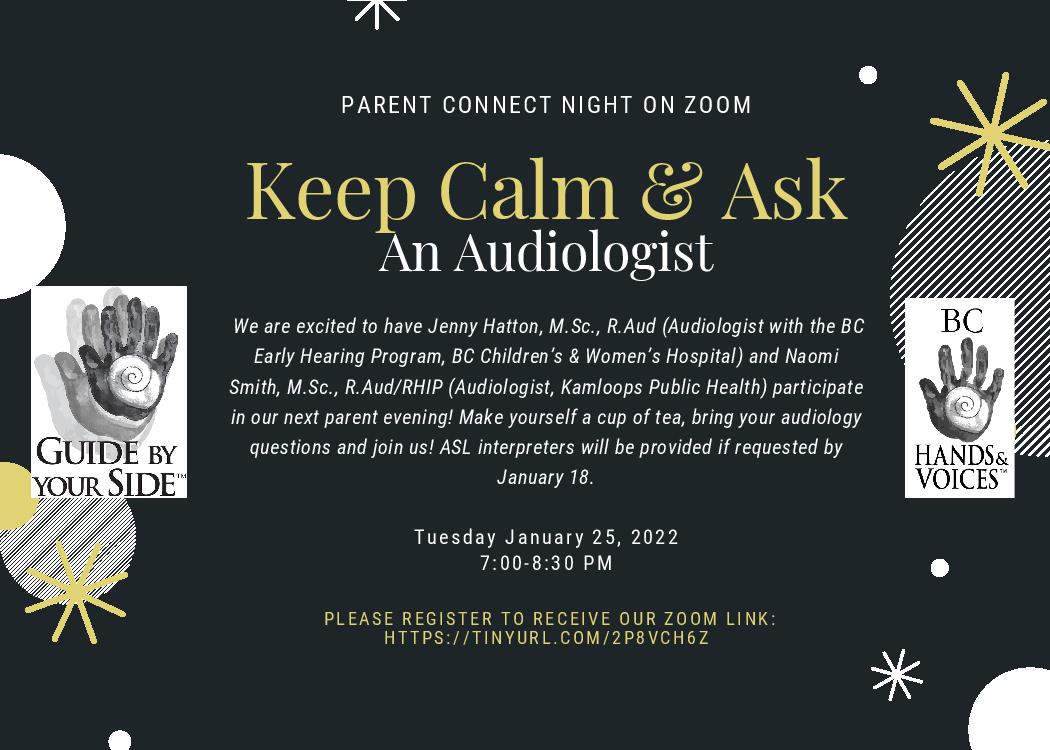
To register please visit: https://tinyurl.com/2p8vch6z
Download our flyer here: Keep Calm & Ask ‘Audiologist’ 1.25.2022
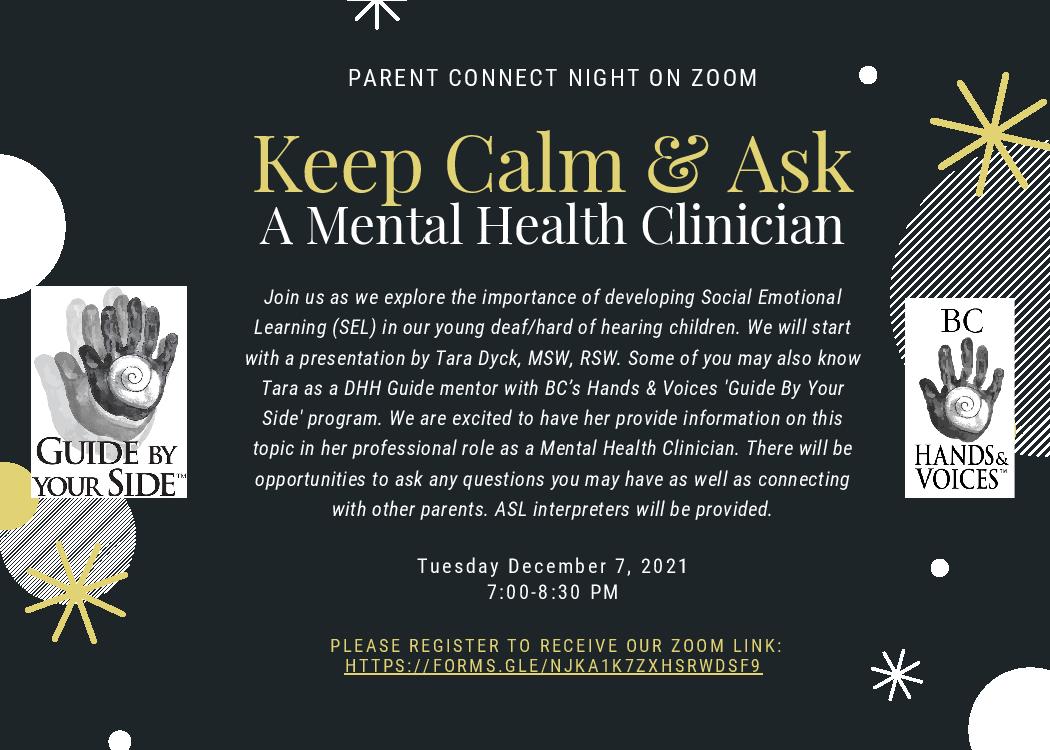
CONTACT/INFO: Please register to receive zoom information here: HTTPS://FORMS.GLE/NJKA1K7ZXHSRWDSF9
Download our flyer here: Keep Calm & Ask ‘Mental Health Clinician’ 12.7.2021
By Kim Shauer
I saw a meme recently of “the best relationships are the ones you never saw coming” from the Minds Journal. https://themindsjournal.com/the-best-relationships-are-the-ones-you-never-saw-coming/. This has resonated for me in many aspects of life, but the most unforeseen have to be the lasting friendships that came out of early intervention services for my deaf/hard of hearing child.

When my first child was born I had a built-in, sustainable network of other moms (friends, cousins and neighbours) who all had babies a few years or months ahead of me. I don’t think I would have made it through that first year of being a new mom without their guidance.
Three years later, just when I thought I may have had the parenting thing figured out, our next child was born with complex health needs. My existing “mommy groups” were still a huge support, but they just couldn’t relate to our situation – as much as they lovingly tried! I quickly needed to put the feelings of fear aside and branch out of my comfort level to seek out another network of parents that I could learn from and feel supported by while navigating through medical appointments, therapies and hospital visits. I mostly found these parents at Infant Development Program groups, in the waiting room at the Centre for Child Development or online through associations supporting her various medical conditions. 
A while later when our daughter was identified as deaf/hard of hearing, we enrolled in additional early intervention programs with deaf/hard of hearing and deafblind services. My cautious personality tends to lead me to avoid emotional exposure, so I still vividly remember feeling uncomfortably vulnerable walking into those first parent and professional groups. It was these groups that provided the start of the relationships with other parents that we still depend on today.
For many years now I have been in a parent support role and involved in the BC Hands & Voices Guide By Your Side ™ program. Parents of newly identified deaf/hard of hearing children with additional needs often share their feelings of isolation, even though they may have lots of people around them offering help. They ask me what I found the most helpful early on, what advice I can provide or what has made the best impact on our lives raising a deaf/hard of hearing child with additional needs.
I can relate to these feelings and questions whole-heartedly. I share some of our story and the benefits found in putting aside fears and any stigma of getting support, and the vast array of services and support options available. Just by getting started and reaching out to have these conversations, parents share new feelings of optimism and empowerment – that it’s okay to accept supports, understanding it’s a show of strength to reach out, not weakness.
I think back to how hard it was in those early days to step out of my comfort zone to attend my first BC Hands & Voices parent night, a BC Hands & Voices spring picnic and later, summer family recreation activities offered by the Canadian Deafblind Association of BC. As the years progressed, we continued to find our community of support by attending activities as a family and learning alongside fellow parents at the valuable workshops and connection opportunities provided by the many wonderful organizations supporting families with deaf/hard of hearing children in BC.
These were the moments where our sense of belonging flourished, where honest, non-judgmental conversations about parenting challenges took place, and where we learned skills to deal with the day-to-day issues of our child’s struggles and gain information and resources to support the resilience of our entire family.
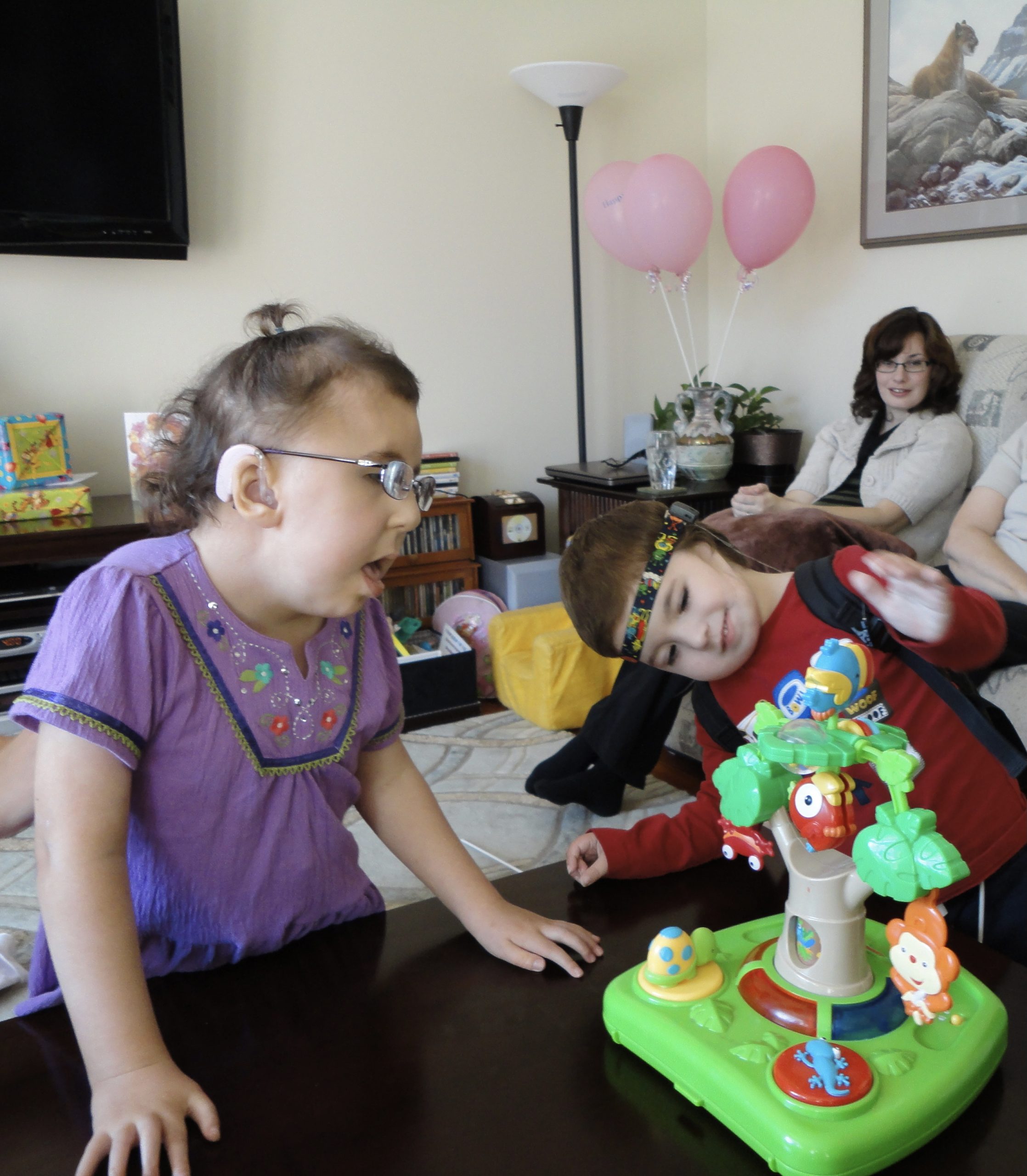
Looking back now, I see how this was also a self-care activity for me, but I would never have recognized it as such at the time! This ended up being how I filled my own tank, with knowledge, community and relationships in order to be able to turn it into caring for my family to the best of my ability. As a parent, I really understood the analogy of needing to put on my own oxygen mask first in order to be prepared to help those around me.
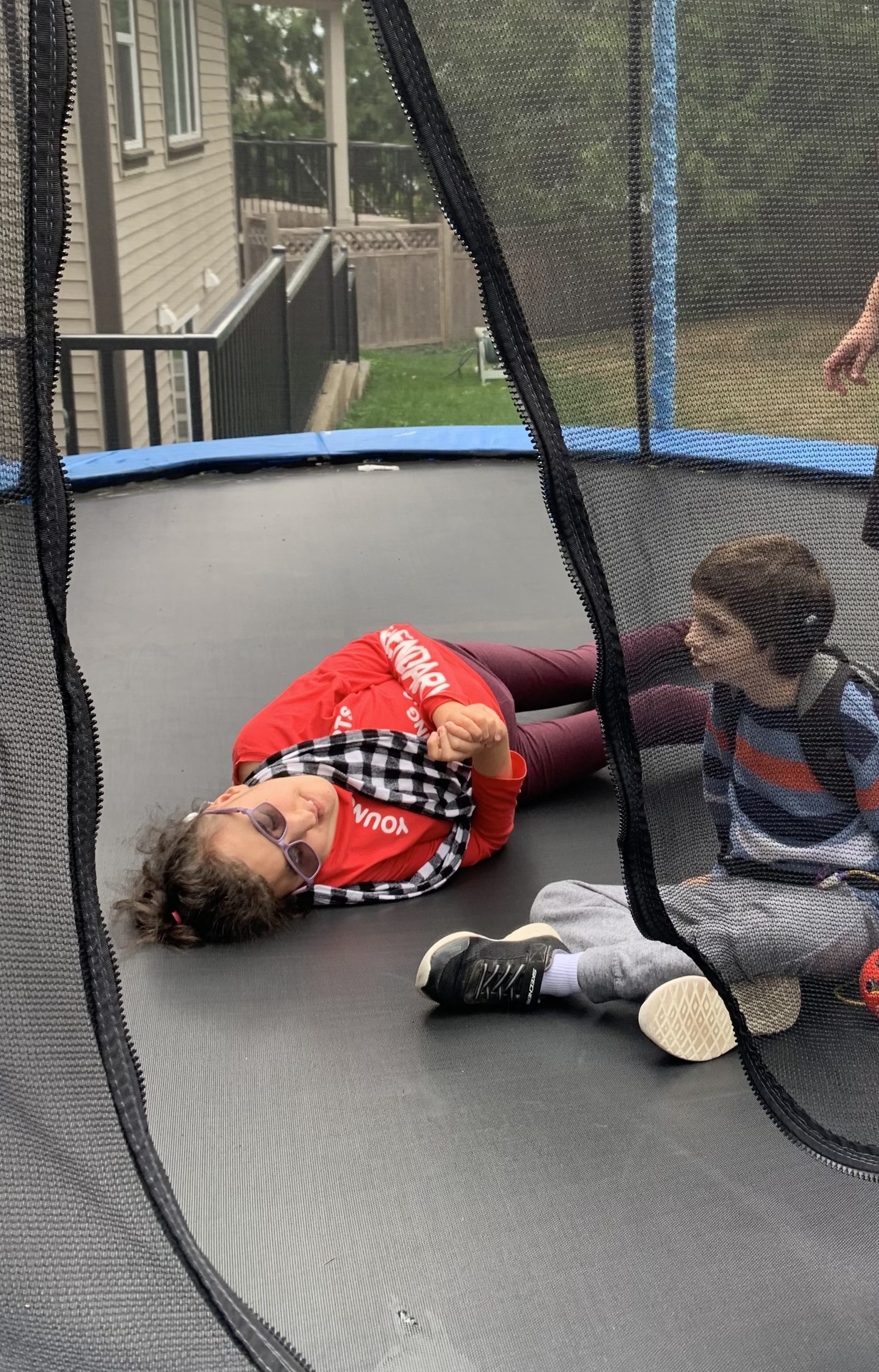
I am so grateful to the many families we’ve met through the years – our children are teenagers now! I would never have anticipated when our kids were a year old that we would still be reaching out to each other today. Every stage along the way seems to bring up more questions and choices to consider in addition to celebrating the array of accomplishments! Our vulnerability with each other is what keeps these relationships thriving. There is no one more equipped to handle our challenges, tears, hope and humour in our experiences than those who really understand what we’re going through.
If you haven’t had the opportunity to benefit yet from parent-to-parent connections, please know you can reach out to me at kshauer@cw.bc.ca. I will do my best to help you find your people and an increased sense of belonging!
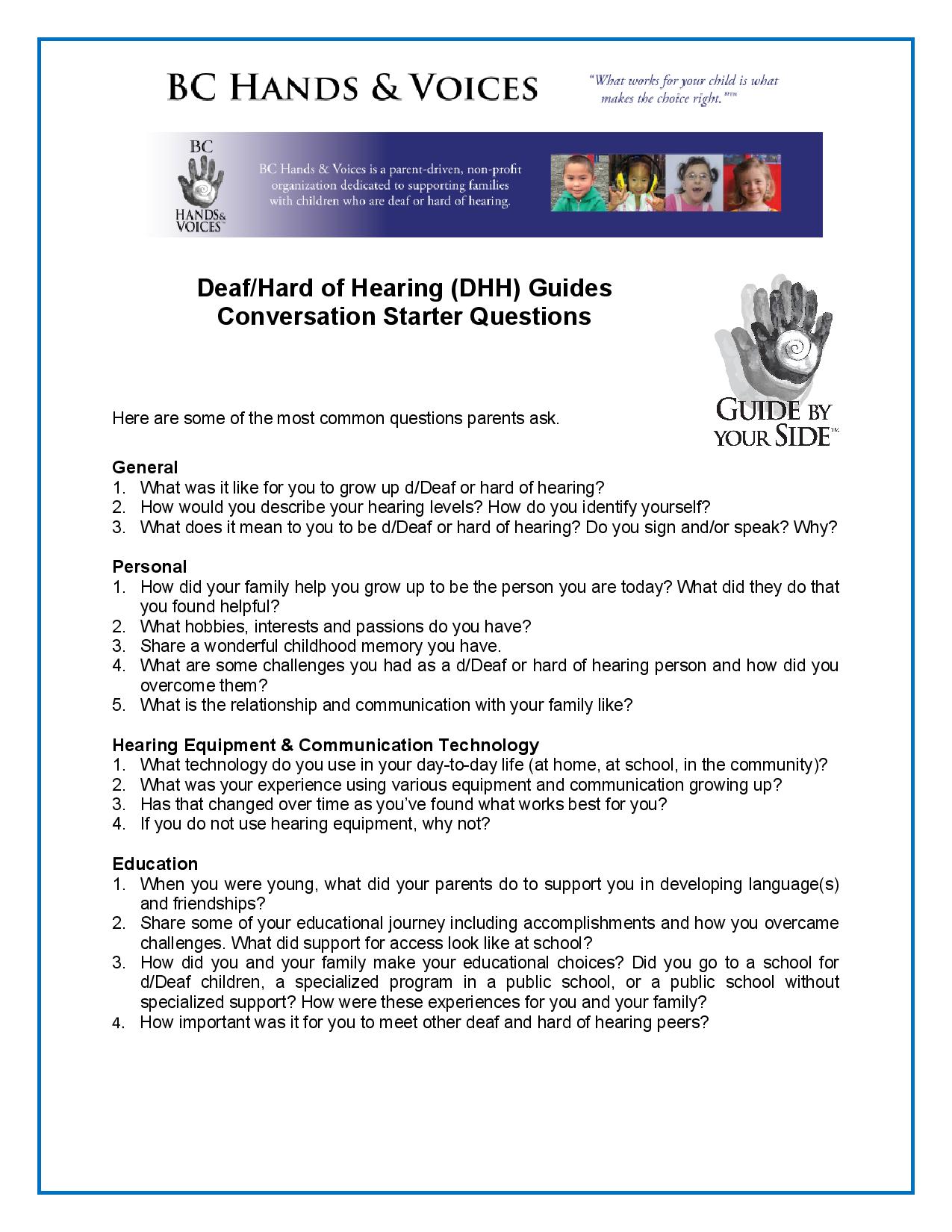
Interested in learning from the experiences of DHH Guide role models, but not sure what to ask? Here are some ideas to help you!
Download it here: DHH Guides Conversation Starter Questions
Author: Teresa Kazemir
When our newborn son was identified as hard of hearing, one of the things we worried about was the possibility that he would be teased or bullied because of his hearing equipment or his small, differently-shaped ears. We learned a strategy early on that is referred to as ‘controlling the narrative’. This is a public relations skill that is often seen in the media – the desire to ‘get ahead of the story,’ or tell it your way before someone else tells it their way.

We wanted our son, Jesse, to develop strong self-esteem and identity, and did not want people expressing sympathy or pity for him. We also wanted to avoid a host of negative words and phrases such as:
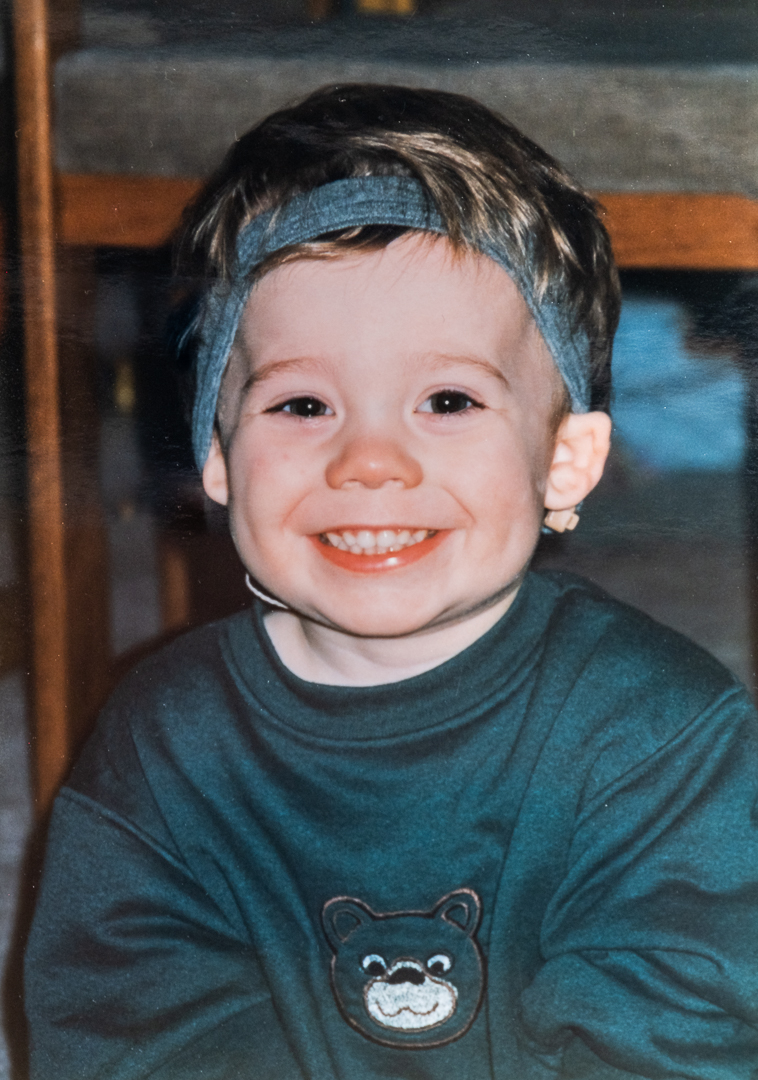
We were amazed at how easy it was to set the tone for conversations with friends, family and even strangers. If we talked openly about our son’s ears, hearing access and equipment, using a matter-of-fact and accepting tone, we found that others seemed to relax and follow our lead. We also intentionally modeled the neutral or positive words and phrases that we wanted Jesse to grow up hearing:
As Jesse grew older, we saw him internalize the language that he heard around him and use it to answer questions and describe himself. We wanted to ensure this would continue as he became more independent and started spending more time away from us. When he started preschool, we created a photo picture book and added captions explaining about his hearing equipment. For kindergarten, we created a one-page brochure for teachers, again modeling the vocabulary and positive tone that we wanted teachers to use when talking about our son. The Teacher of the Deaf and Hard of Hearing led a circle time with his kindergarten class, again explaining about Jesse’s ears, hearing access and equipment. By educating the children in a positive and inclusive way it removed any stigma, and the children were given the appropriate vocabulary (and communication strategies) at an age when they are very accepting.
Over the years, I have seen many variations on these strategies. Some families create colourful brochures about their child to share with daycares, preschools or kindergarten (with endearing photos front and centre). Some write letters to the classmates’ parents, so they have accurate information and appropriate vocabulary to use when talking with their children. Others make a point of meeting with the school team and explaining explicitly what language they want to be used related to their child, and perhaps what terms or labels they want staff to avoid.
All of these strategies can be used effectively to influence how other people talk about our children and help to create a positive and accepting environment where our kids can grow and thrive.
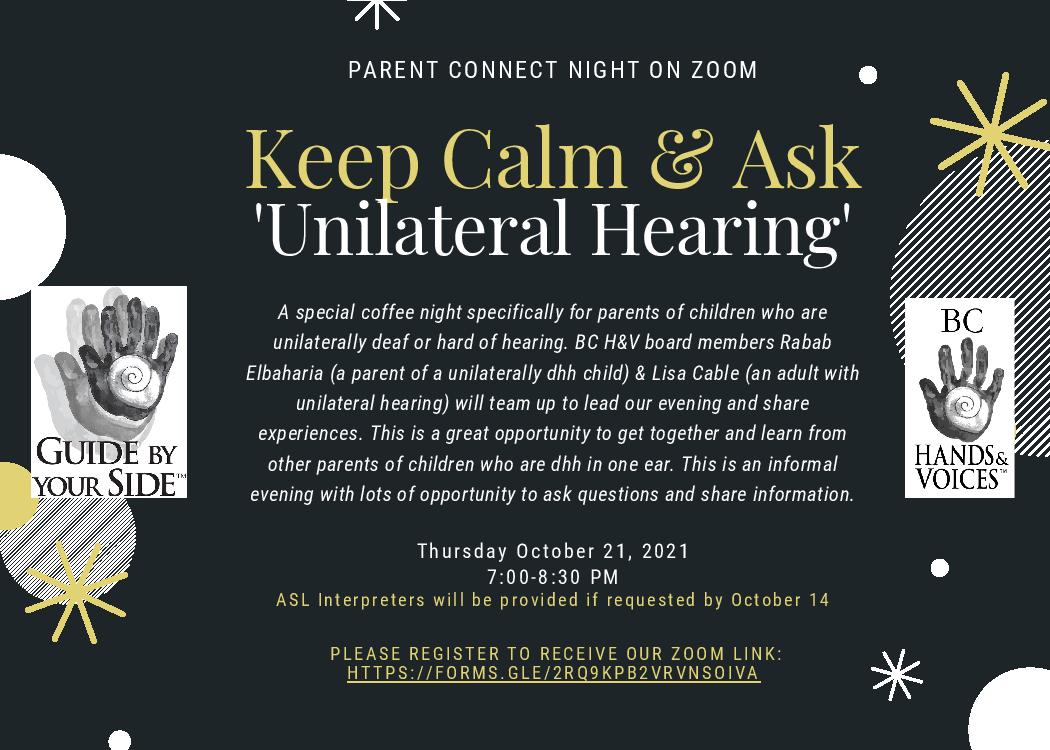
CONTACT/INFO: Please register to receive zoom information here: https://forms.gle/2rQ9KpB2VrvnSoiVA
Download our flyer here: Keep Calm & Ask ‘Unilateral Hearing’ 10.21.2021