My Daughter Swallowed a Battery

By: Bobbi Best

I would like to share a story that as a family we laugh about now, but at the time it did not seem that funny.

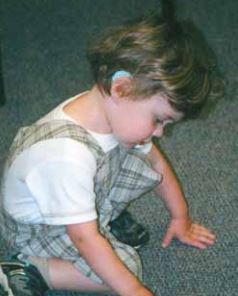
My daughter was about 19 months old and had had her hearing aids for about a month. She was getting used to them and was starting to leave them in and not pull them out constantly. I was cooking dinner and she was sitting on the floor in the living room playing with toys. I was busy in the kitchen and when I looked to see what she was doing, because she was being very quiet, I saw that she had the hearing aid close to her mouth and then I realized she had something in her mouth. I knew as soon as I got to her and saw the hearing aid in her hand without the battery what she had just swallowed. I immediately phoned the nurse help line to find out what I should do. They told me to go straight to the emergency room. Since we were new to the area, I had to find directions to the nearest hospital, and then off we went.

I had my daughter and my two sons with me, as my husband was working at the time. The nurses took us to a room right away, and we did not have to wait long before the doctor came in. He said it was not likely a problem as long as the battery had traveled through the stomach quickly. The doctor said if the battery was in the stomach too long, the acid in the stomach could start to break down the battery and cause a serious reaction in her stomach. So she was sent for an x-ray; luckily for us the battery was in the intestines and was on its way out. So with a sigh of relief we went home. The next day, the battery was revealed in her diaper. No I did not save it, however, the thought briefly crossed my mind! My daughter is six now and she likes to hear me tell the story; she thinks it is funny and a little gross!! I know that most hearing aids for young children have a safety on the battery, but these were loaners and they did not have any to loan us that had the safety. So beware: this could happen to your child, and if it does head straight to Emergency for an x-ray!!

Posted in Newsletter - Dec 2009 | Comments Off on My Daughter Swallowed a Battery

Early Drawing Gives Children an Advantage in Gaining Literacy

Written by Bob Steele
Bob Steele was an associate professor (emeritus) at the University of British Columbia and was with the Drawing Network.  This article first appeared in the Vancouver Sun on March 3, 2009. Reprinted with permission.

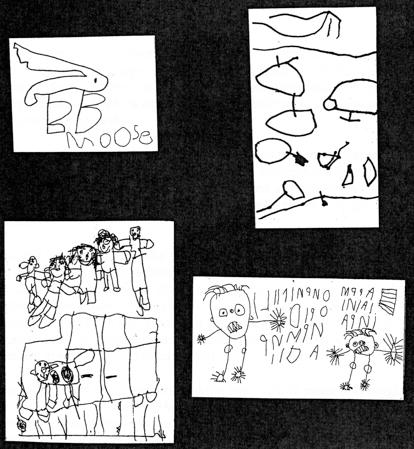
Some 20 years ago a group of parents, teachers and academics got together to foster mental development and literacy in preschool children and beyond. They called themselves the Drawing Network. Language in the broadest sense would be the key and spontaneous drawing the special emphasis. Children begin to draw about the same time they first use spoken words, typically in the second year of life. Nature apparently meant this to be used as a language medium. A fairly consistent unfolding takes place, but only when parents and teachers nurture it in a daily routine. Drawing begins with random scribbling, becomes crude representations and, by age four and with daily practice, emerges as a medium of expression so rich and detailed, so useful in expressing a subtle and complex content, that the definition of language is richly satisfied.

The Drawing Network defines language as articulating, expressing and communicating perceptions, thoughts and feelings. Drawing not only fulfils this definition but has one enormous advantage for the child who must use language to face the world intelligently and with feeling: unlike literacy, drawing has no code and children use it with complete spontaneity.

To end the relative neglect of drawing as a language medium, the Drawing Network suggests the “daily draw” in homes with children. Here is how it works:

  • Simple materials are provided – recycled computer paper, cheap drawing pads, ballpoints pens and safe-to-use fine-tipped felts. The literacy connection begins with a conversation between parent and child about theme. Ideas are exchanged. Shut-eye visualization and guided imagery may be helpful. A story is told, a poem read, a notable event recalled, a household routine highlighted. The adult has no further responsibility, only motivation; no “showing how”, no “ how-to-draw” formulas.
  • Words also come into play during the drawing performance in the form of a silent monologue. Vocabulary is stimulated by drawing “things” in detail; the natural laws of syntax are exercised by echoing the events of the drawing with a silent running commentary. When words seem appropriate they are added to the drawing thus making the transition to writing and reading.
  • The parent returns when the drawing is finished and the literacy connection reconvenes with a post- drawing discussion.

The child who is encouraged to draw has a tremendous advantage over the one who either draws fitfully or not at all. There are developmental gains that include increased perceptual acuity, intellectual growth, emotional, health, a happier learning environment, bonding with parents and other adults, learning to face the natural and human environment with empathy. The unexpected advantage, however, is the easier acquisition of all forms of literacy.

Posted in Newsletter - Dec 2009 | Comments Off on Early Drawing Gives Children an Advantage in Gaining Literacy

My Personal Challenges – Punjabi Translation


by Jenn Kipling

Download this article

Link to English version

Posted in Punjabi ਪੰਜਾਬੀ | Comments Off on My Personal Challenges – Punjabi Translation

My Daughter Swallowed a Battery – Simplified Chinese 我女儿吞下电池!

by Bobbi Best


Download this Article


Link to English version

This translation is made possible with the generous donation of the Gwyn Morgan & Patricia Trottier Foundation.

Posted in Simplified Chinese 简体中文 | Comments Off on My Daughter Swallowed a Battery – Simplified Chinese 我女儿吞下电池!

My Personal Challenge – Simplified Chinese 儿子的听障给我带来的个人挑战

by Jenn Kipling

Download this Article

Link to English version

This translation is made possible with the generous donation of the Gwyn Morgan & Patricia Trottier Foundation.

Posted in Simplified Chinese 简体中文 | Comments Off on My Personal Challenge – Simplified Chinese 儿子的听障给我带来的个人挑战

My Personal Challenge – Traditional Chinese 兒子的聽障給我帶來的個人挑戰

Screen Shot 2012-10-05 at 12.05.17 PM

by Jenn Kipling

Download this article

Link to English version

This translation is made possible with the generous donation of the Gwyn Morgan & Patricia Trottier Foundation. 承蒙 Gwyn Morgan & Patricia Trottier Foundation 慷慨捐助,文章得以翻譯成中文。


Posted in Traditional Chinese 繁體中文 | Comments Off on My Personal Challenge – Traditional Chinese 兒子的聽障給我帶來的個人挑戰

My Daughter Swallowed a Battery! – Punjabi Translation

Screen Shot 2012-10-05 at 11.57.46 AM

by Bobbi Best

Download this article

Link to English version

Posted in Punjabi ਪੰਜਾਬੀ | Comments Off on My Daughter Swallowed a Battery! – Punjabi Translation

My Daughter Swallowed a Battery – Traditional Chinese 我女兒吞下電池!

by Bobbi Best

Download this article

Link to English version

This translation is made possible with the generous donation of the Gwyn Morgan & Patricia Trottier Foundation. 承蒙 Gwyn Morgan & Patricia Trottier Foundation 慷慨捐助,文章得以翻譯成中文。

Posted in Traditional Chinese 繁體中文 | Comments Off on My Daughter Swallowed a Battery – Traditional Chinese 我女兒吞下電池!

Parents Sharing Their Experiences

ANOTHER SUCCESSFUL EVENT BY BC HANDS & VOICES

On Friday, October 16th, BC Hands & Voices held its 3rd event, this time hosting a parent panel. The event was held at Provincial Services for the Deaf & Hard of Hearing, at the Victory Hill site in Burnaby. We would like to express our gratitude to them for allowing us to use their boardroom for our event.

The panel was made up of parents who are either or both on our BC H&V board or who are members of BC H&V and are parent guides from the Guide By Your Side Program. Participating on the panel were: Amy Ho, Bobbi Best, Terri Dauvin, Monique Preer & Chris Mallinson. Each of the parents on the panel hoped to share their experience and knowledge in raising a child with a hearing loss with the parents in the audience and to answer any questions that the audience might have.

14 parents and a family friend attended the evening and made up our audience. Not a bad turn out for such a miserable night… rain, rain, rain. The evening proved to be a success, however, there was just not enough time, as is usually the case.

Upon arriving and settling in, we began by introducing the Hands & Voices board parents and parents on the panel.

MODERATED QUESTIONS COVERED THE TOPICS:

  1. What challenges the families faced and how they worked through them
  2. How they dealt with questions or lack of questions from relatives and friends
  3. How immediate and extended family members were affected by their child’s hearing loss
  4. Their feelings on the roles of Dads vs. Moms

THOUGHTS & EXPERIENCES SHARED BY THE PARENT PANEL:

Dealing with challenges It was difficult to find services in outreach communities. However, supports are available if one is willing to do the work of looking, asking, and sometimes traveling to find them. Being the main person to become educated about hearing loss and what to do to help his/her child. The parent is then considered the “expert” and feels the responsibility of making his/her child’s experience a success. One parent wished she had involved others (family & friends) in appointments and in the education process.

Being new to the country and not knowing what resources were available.

Having to choose a program for services and make decisions like “use sign language or an auditory/oral approach”. One parent felt she needed to make one choice versus the other, but later learned that they could change their approach as their child’s needs changed.

One child was born with many other challenges. When the parents learned that their son had a hearing loss, it was viewed by them as an issue that could be dealt with later, when their child was well enough to come home from the hospital.

Questions or lack of questions from others.

Gave them the facts/information about their child’s hearing loss and hearing aids.

Shared with them some ways to communicate with their children.

One parent commented that, “I am always pleased when people ask me questions about my son’s hearing, as I feel that teaching the people in his life about his hearing loss will ultimately help him.”

IMMEDIATE & EXTENDED FAMILY

Extended family benefited a lot from having children with a hearing loss in the family. They were brought together in a way that might not have happened otherwise. They all learned a lot about tolerance and acceptance.

One son who is sandwiched between two deaf siblings finds it hard sometimes, so his parents do their best to find time to spend with him alone. One parent talked about how her family all went through a grieving process, but was confident that they could handle the challenges, and that their deaf daughter could do as well as their hearing son. She also commented that there was a very strong bond between her older son and her daughter with a hearing loss, and they value each other’s ideas/ views very highly. For example, when her daughter was in Grade 11, she wrote an award-winning contest essay about how her older brother helped her improve her reading skills by bribing her with her favorite candies to get her to read more advanced books when she was in elementary school. A few years later, her hearing son would write a university Psychology paper about how his deaf sister acquired the English language despite her deafness.

ROLES OF DADS VS. MOMS

A Dad’s role is very important and just as important as a Mom’s role. Sometimes, husbands can come to meetings and doctor’s appointments, other times work prevents them from coming. One parent said that she is, “always careful, when I talk at these appointments to say ‘we’ because even though he is not there, it does not mean we have not discussed this at home (together as parents or as a family),” and this should be made clear to the children and others. Mothers and fathers should share the same responsibility.

One couple attended almost all medical and school appointments together except for the weekly physiotherapy sessions for their daughter’s first 2 years. When advocating for their daughter, one husband often edited the letter that his wife wrote so as to add more emphasis to the request by making it more concise.

The only father on the panel talked about how he had attended all of his son’s many surgeries, but felt terribly guilty when he had to miss one minor surgical procedure.

We all agreed that it is important that having both parents active and involved will lead to the greatest success for the child and the overall well-being of the family. It is crucial that everyone feels supported but this can look different in every family. A parent in the audience wished to hear from the panelists about their deaf/hard of hearing children and the children’s participation in group activities such as sports, clubs, etc.

RESPONSES FROM THE PANEL

“My daughter is involved in several different sports. She participates in dance classes, basketball, horseback riding and cross-country running. She likes to ride her bike and four-wheeler. She has joined other activities like piano and choir. We find it helpful to use the FM system when we are going for a family bike ride.”

On self-advocacy: Give your child the choice about providing information about his/her hearing loss to those involved (coaches, instructors, leaders, and the other children). Do they want to talk about their hearing loss themselves or would they prefer their parents to give that information? Ensure your children make people aware of their hearing loss when they are in situations where they cannot hear. For example, children do not wear their hearing equipment when swimming. Tell your child to inform the lifeguard, “I am deaf and can’t hear you” when the lifeguard is talking to him or her. Parents found it really helpful to be a parent helper or leader in their child’s activities. One parent always went on field trips with her son, which was a great time for other parents to ask her questions about his ears and hearing aid. The questions came up naturally and she was able to help them better understand his needs. She recently was a trip chaperone, and even though her son is now a teenager, she was amazed at how many of his peers, other parents, and instructors asked her questions about his hearing.

One parent asked the swimming instructor to let the other children go first so that her son could watch the other children and know what to do, since he couldn’t hear the instructions. She also talked to the instructor or coach ahead of time, with her son, to explain his needs. As the son grew older, he took this role upon himself.

Unfortunately, this was when we ran out of time. We were happy that all the parents had an opportunity to talk and share their stories with each other during the break. We seasoned parents really understand and appreciate the value of parents networking. Thank you to everyone for coming out to this event and for taking part in the evening. For those of you who could not make it, we hope to see you at our next event. We are aware that some of you could not make it due to the fact that we were unable to provide child care. We apologize for this and hope to better meet this need in the future.

We welcome any ideas you might have for future events and please let us know if you have any to share!!

Posted in Events, Newsletter - Dec 2009 | Comments Off on Parents Sharing Their Experiences

Living with Hearing Loss in One Ear

By Diane Goodman

I am 63 years old, and have a thirteen year old grandson who is hard of hearing.

I first noticed my hearing loss in 1990, when I was 44 years old. I was staying the night at a friend’s house, and was irritated by the ticking of the alarm clock. However, when I rolled over in the bed, I couldn’t hear the clock at all. Around the same time, I attended a CNIB workshopand was blindfolded so I could get some idea of what it would be liketo be blind. Once the blindfold went on, I became not only blind, but extremely hard of hearing! I hadn’t realized how much I depended on visual clues to compensate for my hearing loss. Three years passed before I actually had my hearing checked.

Although the findings indicated I did indeed have a hearing loss in my right ear, I chose not to get a hearing aid. Over the years, I have learned some tricks to aid my hearing loss. I always try to walk and/ or sit so people are on my left side. Because my loss is mostly in the lower tones, I have the most difficulty hearing my husband. He also has a hearing loss, so we have some house rules. For example, don’t talk to me if you can’t see me, and call my name to get my attention before you talk to me. Also, because my hearing loss is only in one ear, and I have trouble locating where sound is coming from, tell me where you are! Crowds are difficult. When I am talking to a person in a noisy environment, I try to position myself so they talk into my good ear. Unfortunately, because people like to make eye contact, we end up turning in circles.

Because I don’t wear a hearing aid, I have to inform people of my hearing loss. I am always pleasantly surprised at how accommodating people are. Everyone always knows someone who is also hard of hearing. Actually, most people my age (63) seem to be hard of hearing!

Posted in Families to Families, Newsletter - Jun 2009, Unilateral Hearing | Comments Off on Living with Hearing Loss in One Ear
    Sign Up for Our eNewsletter!
  • H&V Mission (ASL)

  • Guide By Your Side Program (ASL)

  • Diversity, Equity & Inclusion

    We at H&V are looking within ourselves and within the organization to do better in supporting Black lives Matter. Learn more HERE.

  • Upcoming Events

  • Recent Posts

  • Categories