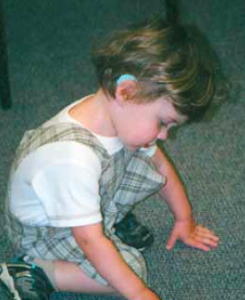
Bilateral BAHAs

Our 14 year old son has bilateral atresia (no ear canals).  He wore a traditional bone conduction hearing aid for several years, and has used a BAHA for the past six years.   This past November he “went bilateral,” getting a second BAHA.  You are welcome to check out his blog, where he describes his experiences going from one to two hearing aids:

http://bahadude.wordpress.com.

Posted in Families to Families | Comments Off on Bilateral BAHAs

My Personal Challenges in Dealing with My Son’s Hearing Loss

My son Connor was diagnosed with a mild bilateral hearing loss at birth. At the time of diagnosis, I went through the typical grieving process but Connor having a hearing loss really didn’t affect me because I myself have a mild bilateral hearing loss and I’ve managed just fine. However, I didn’t anticipate the personal challenges I would face as a parent with a child that has a hearing loss.

My first challenge was my family — my husband and his parents in particular. They had this need to place “blame”, to find a reason for why Connor was inflicted with a hearing loss and that need of reason or blame fell onto me because I of course had a hearing loss myself. And I myself had already been down that road of placing fault onto myself but changed my tune quickly. My hearing loss was caused by a reaction to medication when I was a toddler and the testing showed no indication it is genetic. I feel that on the most part they have gotten over the “blame game”, but every now and then one remark or another will be made and I just cope by ignoring the comment and responding by pointing out something amazing about what Connor is doing or has done and what a great child he is.

My next personal challenge came after Connor was wearing his aids. I love his aids, which are cute baby blue ones that match just about everything that he wears. I was really good about having him wear them. I don’t wear aids myself, and I taught myself to cope without them. I really wanted to make an effort to make sure Connor would feel comfortable growing up with them and not feel embarrassed about wearing hearing aids the way I did when I was a kid. But it then became very evident to me by having the baby blue which stands out, that I would be asked questions about them or Connor. I was totally not prepared for these questions and found myself on the defensive at first. Some examples of these questions and responses are: “Oh what are those things?”, or “What wrong with him?” Or having people snap their fingers to see if he would respond. It really took a lot for me to react calmly so that Connor wouldn’t sense my tension or frustration when I responded, “They are hearing aids. My son has a hearing loss”, or “Nothing is wrong with him. Why do you ask?” or “Do you usually respond when people snap their fingers at you?” (That was not one of my finer moments.) Learning to react calmly has been a great challenge for me and on the whole I do manage to be calm.

My final personal challenges have been in the last year, which has been an amazing year of development. I have been constantly questioned about the fact that Connor even has a hearing loss at all. And sometimes I would even question it myself. So the struggle has been to remind myself that, yes, he has a hearing loss and learning how to explain it to others so that they will understand. “He hears things more quietly than you and will miss sounds and words when he’s in noisy situations” — these I find are the easiest to use.

However, even though I know and remind myself on a regular basis, I have been not so diligent about keeping his aids on. This is mainly due to the fact that he functions so well without them, and he likes to take lots of breaks with them, or take them out and take them apart. Sometimes it’s easier to just leave them out. As I write this, I have challenged myself to be more diligent about my role in making sure Connor wears his aids and I hope that the time off from them hasn’t hindered him in any way.

Posted in Families to Families, Newsletter - Dec 2009 | Comments Off on My Personal Challenges in Dealing with My Son’s Hearing Loss

My Daughter Swallowed a Battery

By: Bobbi Best

I would like to share a story that as a family we laugh about now, but at the time it did not seem that funny.

My daughter was about 19 months old and had had her hearing aids for about a month. She was getting used to them and was starting to leave them in and not pull them out constantly. I was cooking dinner and she was sitting on the floor in the living room playing with toys. I was busy in the kitchen and when I looked to see what she was doing, because she was being very quiet, I saw that she had the hearing aid close to her mouth and then I realized she had something in her mouth. I knew as soon as I got to her and saw the hearing aid in her hand without the battery what she had just swallowed. I immediately phoned the nurse help line to find out what I should do. They told me to go straight to the emergency room. Since we were new to the area, I had to find directions to the nearest hospital, and then off we went.

I had my daughter and my two sons with me, as my husband was working at the time. The nurses took us to a room right away, and we did not have to wait long before the doctor came in. He said it was not likely a problem as long as the battery had traveled through the stomach quickly. The doctor said if the battery was in the stomach too long, the acid in the stomach could start to break down the battery and cause a serious reaction in her stomach. So she was sent for an x-ray; luckily for us the battery was in the intestines and was on its way out. So with a sigh of relief we went home. The next day, the battery was revealed in her diaper. No I did not save it, however, the thought briefly crossed my mind! My daughter is six now and she likes to hear me tell the story; she thinks it is funny and a little gross!! I know that most hearing aids for young children have a safety on the battery, but these were loaners and they did not have any to loan us that had the safety. So beware: this could happen to your child, and if it does head straight to Emergency for an x-ray!!

Posted in Newsletter - Dec 2009 | Comments Off on My Daughter Swallowed a Battery

Early Drawing Gives Children an Advantage in Gaining Literacy

Written by Bob Steele
Bob Steele was an associate professor (emeritus) at the University of British Columbia and was with the Drawing Network.  This article first appeared in the Vancouver Sun on March 3, 2009. Reprinted with permission.

Some 20 years ago a group of parents, teachers and academics got together to foster mental development and literacy in preschool children and beyond. They called themselves the Drawing Network. Language in the broadest sense would be the key and spontaneous drawing the special emphasis. Children begin to draw about the same time they first use spoken words, typically in the second year of life. Nature apparently meant this to be used as a language medium. A fairly consistent unfolding takes place, but only when parents and teachers nurture it in a daily routine. Drawing begins with random scribbling, becomes crude representations and, by age four and with daily practice, emerges as a medium of expression so rich and detailed, so useful in expressing a subtle and complex content, that the definition of language is richly satisfied.

The Drawing Network defines language as articulating, expressing and communicating perceptions, thoughts and feelings. Drawing not only fulfils this definition but has one enormous advantage for the child who must use language to face the world intelligently and with feeling: unlike literacy, drawing has no code and children use it with complete spontaneity.

To end the relative neglect of drawing as a language medium, the Drawing Network suggests the “daily draw” in homes with children. Here is how it works:

  • Simple materials are provided – recycled computer paper, cheap drawing pads, ballpoints pens and safe-to-use fine-tipped felts. The literacy connection begins with a conversation between parent and child about theme. Ideas are exchanged. Shut-eye visualization and guided imagery may be helpful. A story is told, a poem read, a notable event recalled, a household routine highlighted. The adult has no further responsibility, only motivation; no “showing how”, no “ how-to-draw” formulas.
  • Words also come into play during the drawing performance in the form of a silent monologue. Vocabulary is stimulated by drawing “things” in detail; the natural laws of syntax are exercised by echoing the events of the drawing with a silent running commentary. When words seem appropriate they are added to the drawing thus making the transition to writing and reading.
  • The parent returns when the drawing is finished and the literacy connection reconvenes with a post- drawing discussion.

The child who is encouraged to draw has a tremendous advantage over the one who either draws fitfully or not at all. There are developmental gains that include increased perceptual acuity, intellectual growth, emotional, health, a happier learning environment, bonding with parents and other adults, learning to face the natural and human environment with empathy. The unexpected advantage, however, is the easier acquisition of all forms of literacy.
Posted in Newsletter - Dec 2009 | Comments Off on Early Drawing Gives Children an Advantage in Gaining Literacy

My Personal Challenges – Punjabi Translation


by Jenn Kipling

Download this article

Link to English version

Posted in Punjabi ਪੰਜਾਬੀ | Comments Off on My Personal Challenges – Punjabi Translation

My Daughter Swallowed a Battery – Simplified Chinese 我女儿吞下电池!

by Bobbi Best


Download this Article


Link to English version

This translation is made possible with the generous donation of the Gwyn Morgan & Patricia Trottier Foundation.

Posted in Simplified Chinese 简体中文 | Comments Off on My Daughter Swallowed a Battery – Simplified Chinese 我女儿吞下电池!

My Personal Challenge – Simplified Chinese 儿子的听障给我带来的个人挑战

by Jenn Kipling

Download this Article

Link to English version

This translation is made possible with the generous donation of the Gwyn Morgan & Patricia Trottier Foundation.

Posted in Simplified Chinese 简体中文 | Comments Off on My Personal Challenge – Simplified Chinese 儿子的听障给我带来的个人挑战

My Personal Challenge – Traditional Chinese 兒子的聽障給我帶來的個人挑戰

Screen Shot 2012-10-05 at 12.05.17 PM

by Jenn Kipling

Download this article

Link to English version

This translation is made possible with the generous donation of the Gwyn Morgan & Patricia Trottier Foundation. 承蒙 Gwyn Morgan & Patricia Trottier Foundation 慷慨捐助,文章得以翻譯成中文。


Posted in Traditional Chinese 繁體中文 | Comments Off on My Personal Challenge – Traditional Chinese 兒子的聽障給我帶來的個人挑戰

My Daughter Swallowed a Battery! – Punjabi Translation

Screen Shot 2012-10-05 at 11.57.46 AM

by Bobbi Best

Download this article

Link to English version

Posted in Punjabi ਪੰਜਾਬੀ | Comments Off on My Daughter Swallowed a Battery! – Punjabi Translation

My Daughter Swallowed a Battery – Traditional Chinese 我女兒吞下電池!

by Bobbi Best

Download this article

Link to English version

This translation is made possible with the generous donation of the Gwyn Morgan & Patricia Trottier Foundation. 承蒙 Gwyn Morgan & Patricia Trottier Foundation 慷慨捐助,文章得以翻譯成中文。

Posted in Traditional Chinese 繁體中文 | Comments Off on My Daughter Swallowed a Battery – Traditional Chinese 我女兒吞下電池!
    Sign Up for Our eNewsletter!
  • H&V Mission (ASL)

  • Guide By Your Side Program (ASL)

  • Diversity, Equity & Inclusion

    We at H&V are looking within ourselves and within the organization to do better in supporting Black lives Matter. Learn more HERE.

  • Upcoming Events

  • Recent Posts

  • Categories