 “Baby Sign Language is all the rage nowadays!” I exclaimed to myself as I finalized my order on Amazon.ca for Baby Sign Language books and DVDs. I was six months pregnant, and like any other new (and nervous!) mother, I had spent massive amounts of time on an endless quest for information, tips, and latest trends in parenting. I aspired to raise an imaginative and articulate child, and often fantasized of someday having a conversation with my toddler where he or she would tell me stories about their day at preschool, and I was especially looking forward to hearing the ones drawn from the imagination. All my research seemed to suggest the same concept to “Introduce language to your child at an early age.” So it was then that I made the decision to commit to ensuring that my child would be in a language enriched environment, be it spoken or visual.
My DVDs and books had finally come in, I was excited! About five minutes into watching my first DVD, I was already confused. The woman on the television seemed to just be making random hand gestures, and I thought to myself, “This is all supposed to mean something?!” I made sure I knew the basics… “Milk,” “Diaper,” “Bath,” “More,” and “Sleep.” I felt that was enough visual language to let my child know I was making an effort to communicate. Besides, I thought that making sure that I constantly spoke to my child would still be promoting a language enriched environment. Alas, like any other impulse online purchase, the books and DVDs collected dust.
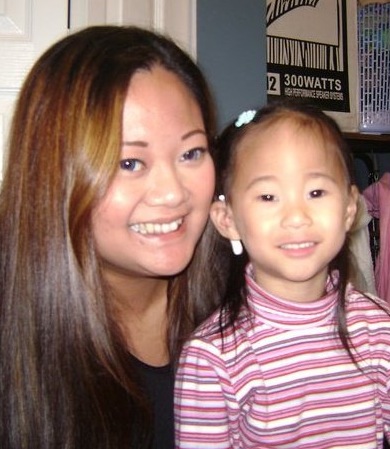
Early Halloween morning, Teanna was born, and she instantly had me wrapped around her tiny little finger. Yes, I was smitten, and I wanted to give her the world. She was a tiny girl, yet in spite of her petiteness, it was already apparent that she had a big and captivating personality. Even as an infant, she seemed to be extremely observant, her eyes wide, a naturally curious expression, and her head constantly turning as if to absorb everything going on in her surroundings. I spoke, sang, and signed the very limited amount of signs I knew with my daughter. She smiled and giggled no matter what I did, she was a happy child, and I, a sleep deprived but nevertheless happy mom. At 8 months old, she signed “diaper,” and when checked, had actually needed a diaper change. I was floored, to say the very least – my child was communicating! At 10 months, she had learned to sign “sleep,” and I would have to gloatingly say that bedtime was always such a breeze. I loved her, and I was happy, but there was a part of me that felt like there was something that was not quite right.
By the time Teanna had turned a year old, she was happy and healthy as ever. However, there still seemed to be some sort of disconnect, a gnawing feeling, if you will. I have had suspicions regarding her hearing since she was born, and it was not until she was 19 months old that she was officially diagnosed to have been profoundly Deaf in both ears. It was a rough and emotional experience, and not only had I felt like I was mourning the loss of something very important, but I was also lost as to what to do next. It was an overwhelming time, filled with so much information from a multitude of resources. It was a time for life-altering and time sensitive decision making, and frankly, I had begun to feel so numb from it all, that it felt like I was simply being carried along the chain of events.
Teanna had immediately gotten fitted for hearing aids, and I felt it was the best decision to choose an intervention program where both a Sign Language Instructor and Speech Language Pathologist would be available. Having an actual instructor for American Sign Language (ASL) made learning it easier. I discovered just how visual the language is, as most of the signs are reminiscent of the English word definition. It definitely was not just a “bunch of random gestures” made in an effort to convey a thought. ASL is an actual language, with grammatical rules that needed to be followed. As much as I found the learning process enjoyable, it took some time for me to feel comfortable using it, even with the instructor. However, as unnatural as it felt, I knew that it would benefit my daughter, so I made an effort to sign with her as much as I could when it was just the two of us. There were many aspects of ASL where I felt slightly awkward. One example being the use of very pronounced, almost exaggerated facial expressions. Raised eyebrows when asking a yes or no question, a furrowed one when asking one that needed a more detailed reply. Pursed lips when describing something that is small, and saying “cha!” with eyes wide to describe something large. It was a time of adjustment.
As with most languages, ASL was accompanied by a culture of its own, the Deaf Culture. Throughout my journey, I have come to learn that Deafies are a very warm and welcoming bunch. I was noticing Deaf people everywhere! I would muster up the courage to approach them in restaurants, at the mall, and I had even found a church that had a Deaf ministry. I had mastered signing, “Hi, my name is Joy. I saw you signing, are you Deaf? I have a daughter who is Deaf, and I am learning Sign Language very slowly.” When a Deaf person sees you making an effort to communicate in their language, their eyes light up, and they are more than willing to sign extra slowly, or even try and speak to have a conversation with you. It was a great feeling when I saw that I, a hearing person, could have a sensible conversation with a Deaf person. In the Deaf Culture there is Deaf Pride, which states that a Deaf person can do anything except hear. I found the culture to be extremely interesting, and begun to immerse myself in it at my own time. I read books, articles, and websites – I wanted to be educated, after all, this IS my daughter’s culture.
Teanna received a Cochlear Implant in her right ear in the Winter of 2009. She currently goes to a preschool where both Deaf children, and children of Deaf adults (CODA’s) attend. In school, the teachers both sign and speak. She receives Speech Therapy every day, and is showing steady progress, as she is currently babbling and making great efforts to speak certain words. She is also recognizing various words that she hears. Her Sign Language skills continue to impress me, she is becoming quite fluent, and at times I feel like I am starting to trail behind. Through Sign Language I can see that she is clever. “I want juice, please,” she asked me one day. “I don’t have juice for you right now, just water,” was my reply. She held up a grape that she was snacking on and signed, “Ok, there is juice inside the grape,” then ran off to play. Through Sign language I can see that she has a sense of humour, she jokes around and I know what types of things she finds funny. Currently she has many imaginative stories involving slapstick comedy. Through Sign Language she is able to voice her emotions, recall past events, and express what she hopes to do in the future.
Personally, the decision to give my daughter a combination of the Cochlear Implant, speech, and American Sign Language is what works for us. There is no doubt that it keeps the calendar pretty full, but it also poses plenty of perks. Teanna will be bilingual, and I feel that she is able to receive the best of what being Deaf and hearing has to offer. Growing up, I lived an expatriate childhood, and I would constantly be reminded that it is important to “remember my roots.” I believe that the decision to educate and involve ourselves with Deaf Culture is giving my daughter a solid foundation as to who and what she is. It is a fact that I am raising a Deaf child in a world that is predominantly hearing. Being involved in the Deaf Community gives her a sense of belonging, and surrounds her with people with whom she shares something in common. I believe it is this involvement that will give her a strong sense of self, thus giving her the confidence to venture out into the hearing world. Teanna will be faced with having to make various decisions about her life as an adult. With the foundation that I am laying out for her, I strongly believe that I am giving her all the tools she may need, no matter which path she chooses. I too, am preparing myself to be in a position to support her decisions. When she was born and I held her for the first time, I knew I wanted to give her the world… Now, she has both the Deaf and hearing worlds at her fingertips.