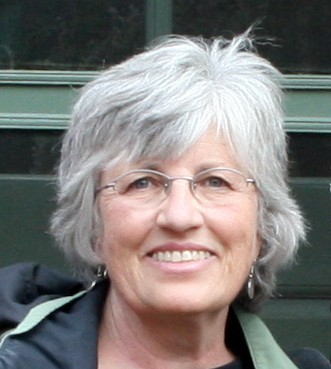
Christine Yoshinaga-Itano, PhD
April 2010
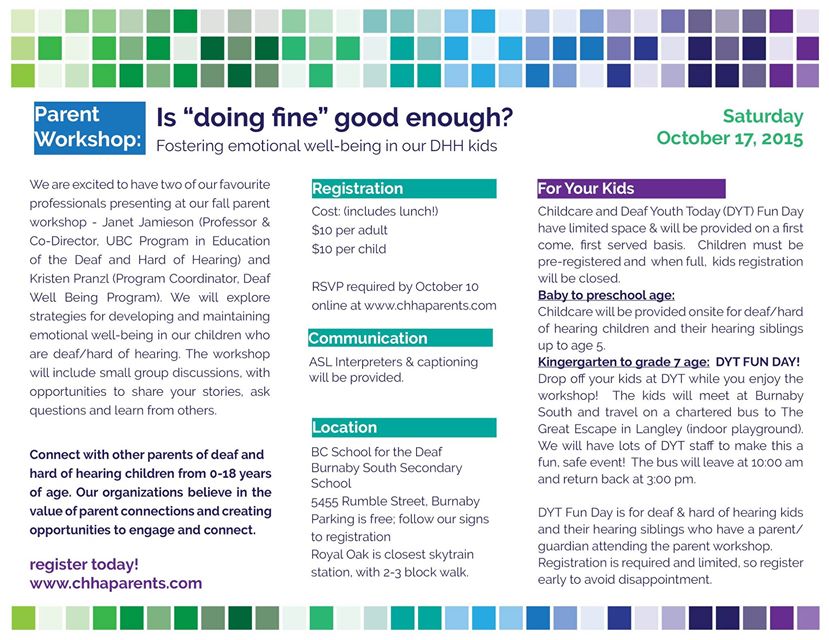
Each year, BC Hands & Voices is proud to host a full-day educational workshop for parents, providing parents with an opportunity to learn, connect and socialize while offering childcare for the youngsters. This year on October 27, 2012, Children’s Hearing and Speech Centre of BC graciously provided the venue for our fall workshop. And what a turnout! Approximately 100 people attended, and it was great to see parents, grandparents and children alike in the mix. The interesting and revealing stories of our two presenters and board members – Alayna Finley and Felicia D’Amato – had our audience riveted in the morning. And in the afternoon, a question-and-answer period with a panel of deaf and hard of hearing (d/hh) young adults, facilitated by Teresa Kazemir, was eye-opening and informative.
Since the vast majority of deaf and hard of hearing children are born to hearing parents – I believe the statistic is around 90% or so – it can be difficult for parents to fully understand their child’s experiences, as hard as they might try. And we know our dedicated parents really try! That’s why it was so great to see so many people out at the workshop. You can’t get much better than firsthand stories about growing up deaf or hard of hearing than from individuals who have done so themselves.
It seemed that the main message taken away that day was yes, there will be challenges and yes, at times obstacles may present themselves, but dream BIG for your child and shoot for the stars! Our children are capable of greatness. Each person is born with a gift, and as parents, we can help our children discover and develop it, whether it’s a love of language, the gift of listening and empathizing with others, a passion for music or athletic talent.
Though parents generally tend to play a positive role in their deaf or hard of hearing child’s life by being involved and providing good educational and extra-curricular opportunities, limits can still come from within. They may take the form of holding back, feeling ashamed about their hearing loss, avoiding group situations, resorting to social bluffing, or simply thinking limiting thoughts. A lack of positive older d/hh role models can also contribute to this.
In particular, Felicia and Alayna talked about group situations, which can be very challenging for people who are deaf or hard of hearing. Just trying to lip-read and keep up with the pace of conversation as it shifts from person to person can be exhausting. And if you miss something that is said, it’s easy to lose the overall meaning of the conversation. Quite often, people don’t want to draw attention to themselves when this happens, so we carry on, nodding and laughing on cue even though we can no longer follow. At some point, we’ve all done this – it’s called social bluffing. But for deaf and hard of hearing individuals, this experience can be even more frustrating, and one might be tempted to avoid group situations altogether.
Enter the paradigm shift: “…a change in your way of thinking, a revolution, a transformation. It doesn’t just happen, rather is driven by an agent of change.” – Thomas Kuhn
There are, however, ways to feel more successful in these situations – if you can change your outlook, or shift your paradigm. Start out by telling the people that you’re with what you need, how you communicate or what you understood. This is a big first step, and we can encourage our children to do this from a very early age. “Can you come closer so I can hear you better? Do you mind facing me so I can see your lips?” It was pointed out that with deaf or hard of hearing people who speak well, it can be easy to forget that they can’t hear so well. And as hearing aids and cochlear implants get sleeker and smaller, it may not always be obvious that a person is hard of hearing or deaf. Felicia found that once she started opening up about this, she was able to build more trust with people and forge stronger relationships.
Developing strategies to initiate conversations and setting up a social environment to your benefit can help too. Alayna suggested that families think ahead before going to family gatherings and think of some activities or even games they can bring. This allows for hands-on fun and connections to be made between family members regardless of communication styles.
The presenters both mentioned that they also try to balance out their environments. They explained this to mean having different circles of friends, and depending on how they feel on a given day, choosing to spend time with either hearing or deaf/ hh friends and family.
Felicia and Alayna also expressed the importance of introducing your child to deaf and hard of hearing role models. Many children don’t meet deaf or hard of hearing adults until they are older. And if you look, there are deaf and hard of hearing people doing some amazing things out there!
Some better-known examples are:
“What a caterpillar calls the end of the world, the master calls a butterfly.” – Richard Bach.
Role models closer to home, who participated in the afternoon guest panel, ranged in age from 17 to 30 years of age. They included Kelsey Grazier, Jesse Kazemir, Bowen Tang, Felicia D’Amato, Cole Sanderson and Alayna Finley. These remarkable young adults had much to share about how technology helps them communicate, special interests, how they practice self advocacy and the role their families played in their acceptance and inclusion over the years.
The group agreed that technology plays a key role in their lives – from vibrating alarm clocks and flashing smoke detectors to the FMs they had worn during their school years. They all rely of course on cell phones and mobile devices for texting and messaging. Software applications like Skype and FaceTime have changed the way ASL-users communicate, as the ability to have face-to-face conversations in their chosen language is not only convenient but also more personal and natural.
The Internet has also brought so much information to our fingertips. Parents were urged to prepare their child in advance for special events, outings or new experiences by gathering material online. One example was looking up song lyrics before attending a music concert. In addition, the panellists suggested to parents to switch on the captioning option on your TVs even if your child can’t read yet. And speaking of captioning, what kid doesn’t like to go to the movies? So the move towards more and more captioning in theatres is great too.
Growing up, all of the young adults on the panel had taken part in a great variety of extra-curricular activities and sports. Be it swimming, volleyball or baseball, playing instruments, taking part in clubs at school or traveling – nothing stopped them. And this is a good reminder for us parents! By trying out different activities, our children will discover for themselves where their interests lie. And adaptations can always be made in order to accommodate a child’s communication needs in a chosen activity – like hand signals with the baseball coach or one-on-one swim lessons.
With regards to traveling, one participant mentioned that although a language barrier in a foreign country can be intimidating, she deals with communication challenges every day, so traveling has fostered a real confidence in her. On school trips, with a sports team, music troupe or independently, the panellists have each sought out opportunities to see the world.
In travel or everyday life, a concept that kept coming up was the need for self-advocacy, or speaking up for yourself and your communication needs. This is a skill that we begin to introduce to children at a very young age and it takes time, practice and self-awareness to develop. Self-advocacy will also take different forms at school, at a sleepover or at swim lessons. One panellist pointed out that advocating for yourself isn’t easy. “You’re putting yourself out there, exposing yourself”. She remembered at school sometimes friends would say “oh, never mind” when she missed something, but for her that wasn’t ok. It was important for her to hear everything that was said by her friends – even the trivial stuff.
Self-advocacy can also mean telling the airline staff that you won’t be able to hear the intercom announcements on the flight and ask that someone come and tell you what is said. In sports, one panellist mentioned it was helpful to not go first in swim lessons so that he could watch a few kids do it first. Another tip was to tell the instructor or coach that you need a clear line of sight so you can understand their instructions better.
“I don’t really see hearing loss as a disability; it’s just a different way of being. We just need to ask “what do these kids need in order to communicate and understand?”
– Kelsey Grazier
As the presenters and panellists shared their stories throughout the day, one thing was obvious – these young adults had first and foremost been loved and accepted for who they were by their families. And they each spoke of this with gratitude. One panellist remembered the long conversations his parents had with him as a child. Another said, “Growing up, I was just Alayna” and only realized later that she communicated differently. Another said that in his family everybody learned to sign, so that was the norm for him. Yet another said that her parents never set limits as to what she could do, letting her try whatever interested her, and this carried over into how she perceived herself.
As parents, the perspective – or paradigm – we take towards our children’s potential can play a big role in shaping not only their self-image, but also their outlook on their abilities and their future. Realistically parents know that challenges will arise as our d/hh children participate in and explore the world around them. So by recognizing these “limits” and teaching our children to reframe their approach and work through them, we provide them with important life skills needed to persevere and succeed. And by demonstrating assertiveness, a positive attitude and creative problem-solving skills ourselves, our children start to believe from a very young age that anything is possible. Our children can and should reach for the stars and have lots of fun along the way!
“Deaf people can do anything…just not hear.” – a quote from a past president of GaulladetUniversity and personal mantra of Cole Sanderson.
——————————–
BC Hands & Voices would like to extend a big thank you to the BC Early Hearing Program, BC Children’s Hospital Foundation and the Gwynn Morgan-Patricia Trottier Foundation and to Children’s Hearing & Speech Centre of BC for the use of their facility.
We are also grateful to Dan Paccioretti for supplying the audio equipment, setting up the gym for optimal hearing and for being available to our audience for questions and information.
And as with all events such as this, we recognize and appreciate the many hours put in by board members and volunteers, our presenters and panellists.
Thank you everyone for your time and hard work. Your contributions all helped to make the Fall Workshop 2012 a big success!
————————–
Two web links that were mentioned at the workshop are listed below for your enjoyment. Check them out!
“A Perspective On Hearing”, a short documentary by Kelsey Grazier on Vimeo http://vimeo.com/44541800
“We Are Going to be Friends” song by the White Stripes, D-PAN Music Video with ASL on YouTube http://www.youtube.com/watch?v=IbLz9-riRGM
Come on out for coffee, treats and the chance to get to know other parents of kids with hearing loss. It’s a great place to share ideas about how to support your children with hearing loss.TOPIC: TBA
Come on out for coffee, treats and the chance to get to know other parents of kids with hearing loss. It’s a great place to share ideas about how to support your children with hearing loss.TOPIC: In Search of Nirvana – BALANCE
We all know what it means and we can probably even picture how it must feel…but in our busy lives with young deaf or hard of hearing children, how do we get there?
Come out on Monday, April 15 to hear stories and share tips on that elusive thing called balance.
Sunday, April 14, 5:45 – 7:45 PM
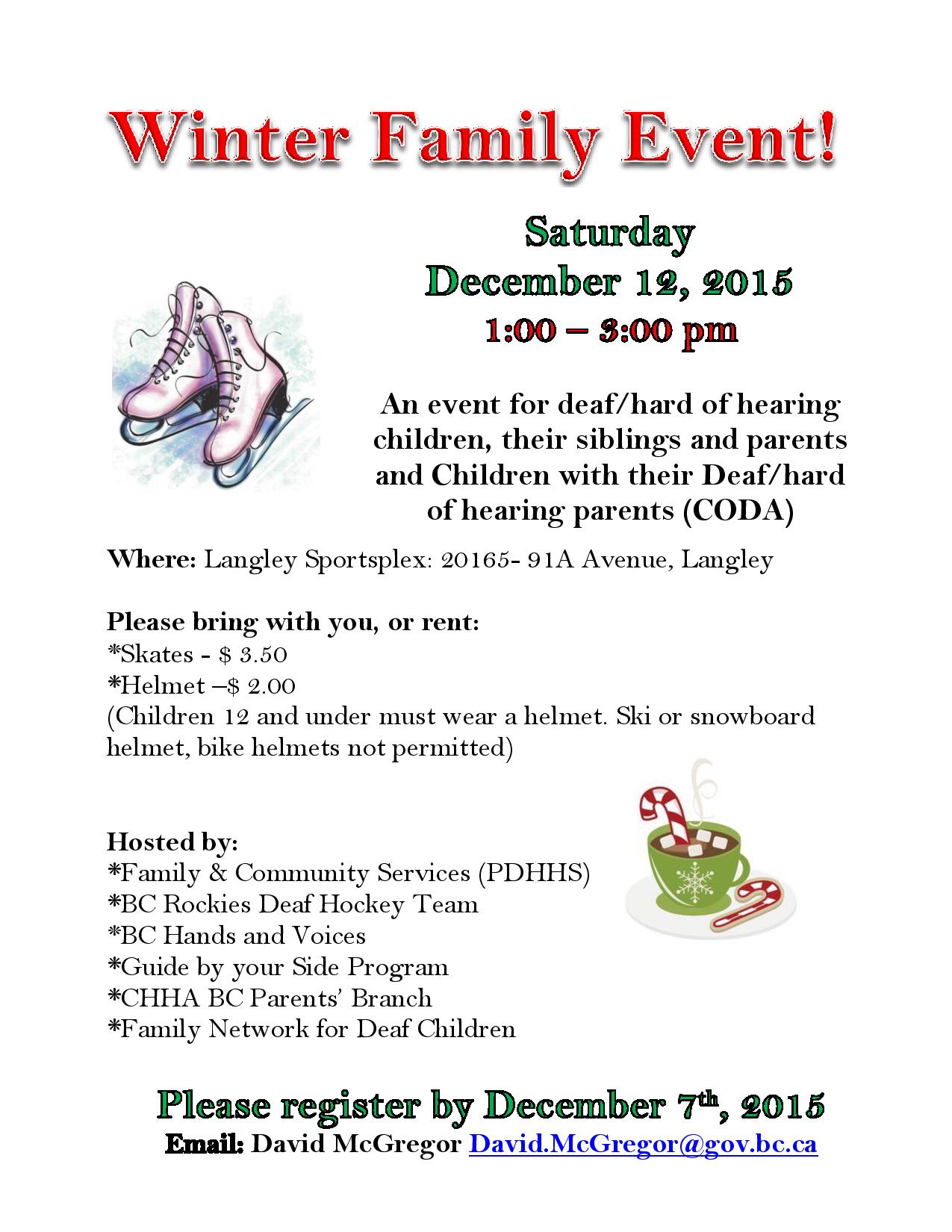
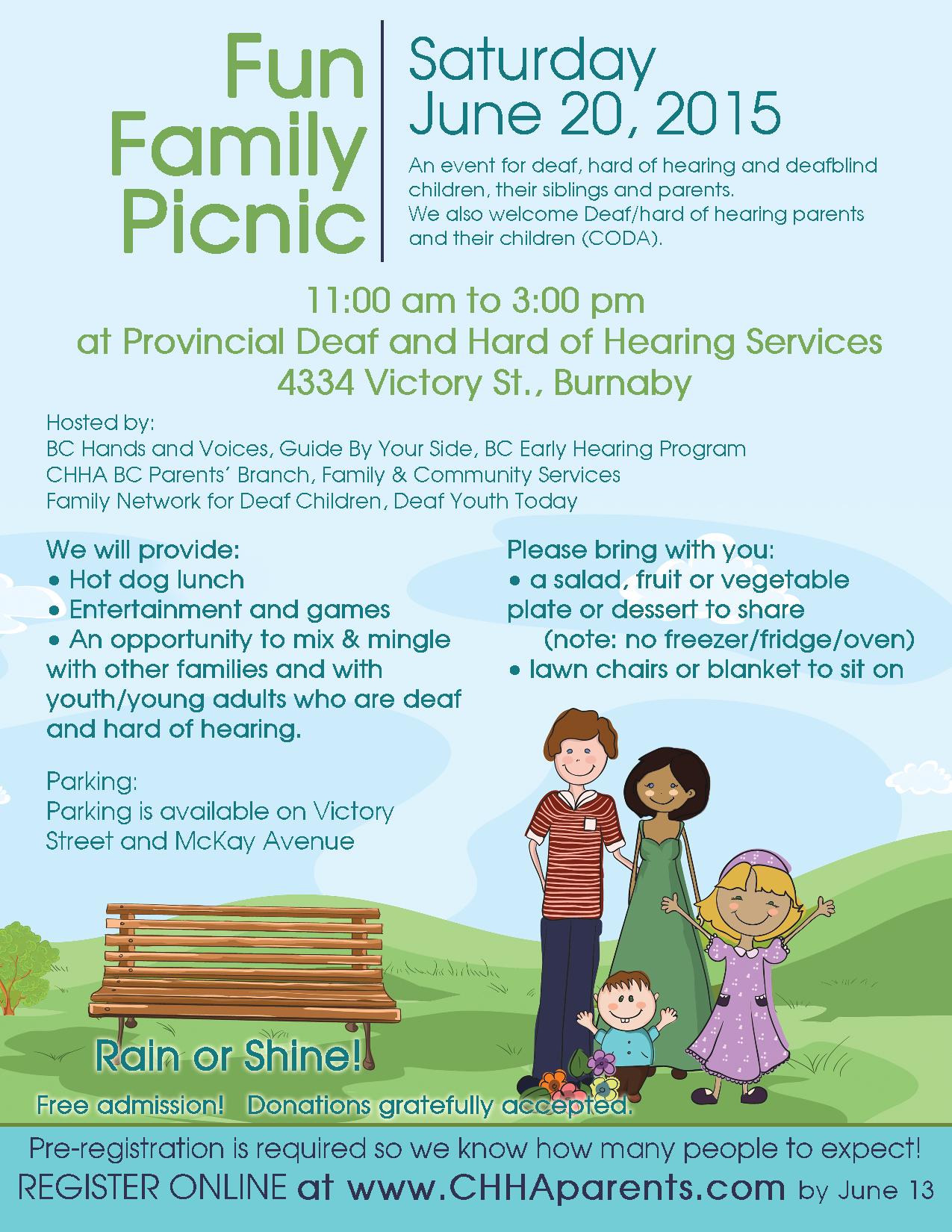
BC Hands & Voices, Family Network for Deaf Children, and CHHA BC Parents’ Branch invite families with deaf/hard of hearing children to a fun family event!
Come join us at this indoor play centre for a chance to network and get to know other families in a relaxed, safe, fun environment. Download the event flyer here.
This event is for deaf/hard of hearing children, their siblings and parents. All children must be age 10 and under.
REGISTRATION IS REQUIRED, Entrance by donation, Snacks provided!
Entrance by donation at the door. Must pre-register at www.CHHAparents.bc.ca
For more info on the venue, click on www.gobananaslangley.com
Come on out for coffee, treats and the chance to get to know other parents of kids with hearing loss. It’s a great place to share ideas about how to support your children with hearing loss.Spring Break is coming and many of us are going on vacations or signing our kids up for special activities and programs in the community. Be it an upcoming airplane trip, soccer practice or swimming lessons, an Easter egg hunt at the community centre or skydiving (ha! just kidding), we will be sharing information about how we make these situations work for our children who are deaf or hard of hearing.
You are invited to the BC Hands & Voices ANNUAL GENERAL MEETING
Provincial Services for the Deaf & Hard of Hearing – House #2
4334 Victory Street, Burnaby (look for the balloons)
The business part of the meeting will be short, followed by treats and a chance for discussion and an opportunity to learn more about BC Hands & Voices. Sorry, no childcare available. Just a reminder – 2013 membership fees are now due, and we will be happy to collect at the AGM ($15 for an individual or family, $25 for an agency). This also entitles you to vote! Please take a moment to read through the minutes from last year’s meeting, available here.
For more information, please contact info@bchandsandvoices.com.
Come on out for coffee, treats and the chance to get to know other parents of kids with hearing loss. It’s a great place to share ideas about how to support your children with hearing loss.
Come on out for coffee, treats and the chance to get to know other parents of kids with hearing loss. It’s a great place to share ideas about how to support your children with hearing loss.BYOA! Bring your own audiogram to coffee night this month. We will be take some time to decipher and understand better our children’s audiograms. What do all those symbols even mean? Feel free to peruse the attached link beforehand, or we will have copies available on Monday night as well. As always, we hope you join us for warm drinks, homemade treats and the opportunity to meet other parents who have young children with hearing loss. We hope to see you there! http://www.babyhearing.org/HearingAmplification/HearingLoss/audiogram.asp
Come on out for coffee, treats and the chance to get to know other parents of kids with hearing loss. It’s a great place to share ideas about how to support your children with hearing loss.Please RSVP to Jennifer at jtowers900@gmail.com.