Sisterhood: Reflections on Growing Up with a Hard of Hearing Sibling

By: Sheryl Hatton

I must admit, I was pretty excited when I sat down to write this piece; reflecting on my experiences as a typically hearing sibling of a child with hearing loss brought back lots of fond memories. I should clarify, however, that with just the one sibling, having a sister with hearing loss was my normal, and I don’t have personal experience of having a sibling without a hearing loss. I had never been a big sister before, so that was a new adventure in itself. Just like any older sibling, I remember having to learn to share everything: my toys (when she stole them), my clothes (when she stole them), my friends, and my parents! Having a hard of hearing sister meant that I also got to experience other things that many kids don’t. It’s a lot of fun to look back on this now as an adult, and I’m happy to share some of these memories with you.

Jenny's Old Family Photos (Roxy Edits) (3 of 23)

We learned of my sisters hearing loss when she was two years old. At this point, I had just started school, and was old enough to understand what was happening with her. Some of my earliest memories are from my sister’s audiologist and ENT appointments; I have very vivid memories of a tiny toy monkey  “jumping out” from a box and banging miniature cymbals!

Sheryl + Jenny Kids

My sister’s hearing loss was identified as moderate to moderately-severe sensorineural  hearing loss for both ears. Once she was fitted with hearing aids, her language developed very quickly. I remember watching my mom work tirelessly to teach my sister letter and word sounds; “tum”, ‘bum” and “thumb” were a particular challenge and frequently mixed up early on…at times to my enjoyment. I don’t recall thinking this was strange or different than what my friends would see in their homes. Although I knew that she went to a specialized pre-school to help her in her speech and hearing development, I never really thought anything of it.

I do remember being intrigued with all the cool things that my sister got to do, and that I wanted to experience them for myself. Rituals with us laying in bed with hydrogen peroxide tickling our ears as it bubbled was a particular highlight. (Warning: do not try this at home without the advice of your doctor!). In retrospect, I learned from this that too much earwax can be a problem for a child who wears hearing aids but at the time, it was just a lot of fun for me. I very much wanted to be involved, and took great enjoyment in helping our mom test hearing aid batteries and the hearing aids themselves with a stethoscope. This skill came in useful when my sister entered grade school; I was given the task at school of testing her “phonic ear” (FM system) each morning until she was old enough to do it herself. I took great pride in that role. 

At home, I figured out, much to our parents’ frustration, that jumping up and down on the floor on one side of the house was a great way to get my sisters attention when she was on the other side. I also learned to enunciate my words, speak loudly, face her when I was speaking, and use my hands to enhance my speech. These were not things that were taught to me explicitly, just ways that we naturally adapted. As an adult, and a teacher, I am very grateful for these early lessons in communication strategy.

I also realized that having someone who can lip-read in your life is both a blessing and a curse; it’s great if you want someone to help you spy, but not so great if you are trying to have a private conversation with someone else! Although I never would have admitted it to my parents at the time, I often tormented my sister by mouthing insults at her (so my parents wouldn’t hear it), just to get her riled up. Despite my role in her torture, I was intensely protective of my sister at the same time, and would never have let anyone else get away with similar actions. 

My sister had her share of annoying quirks too, and she certainly knew how to use her hearing aids to her advantage. When she didn’t like what someone was saying, she found her own means of tuning them out. What began as a toddler telling us “no-talka-me” and turning off her hearing aids, evolved into a chant of “I don’t have to listen to this….I don’t have to listen to this…” followed by the familiar click of hearing aids being switched off. As a teenager, she would use the excuse of “oh, my hearing aids weren’t in, I didn’t know you were waiting” to ensure she got more time in the washroom than me before school each morning. I, in turn, learned how to pick a lock!

As we grew up, I saw my sister develop many friendships, play sports, camp, swim, and excel at a mainstream school; all things one would expect from a child with typical hearing. As a teen, though, I was aware of my sister’s insecurities around people seeing her hearing aids, and I would see her struggle in situations with a great deal of background noise. Like anyone of that age group, she didn’t want to be different. I never truly understood those challenges, most likely because for me she was just like everyone else. 

In all, as a sibling of a child with hearing loss, I can honestly say I wouldn’t change a thing. Our lives were pretty normal. Our childhood was fun and rich. My experiences have helped me to be a more aware and empathetic person, and inspired ongoing curiosity to learn about unique learning strengths and needs. In many ways, her “impairment” has been a gift in helping shape who I am today. 

Posted in Articles, Families to Families | Comments Off on Sisterhood: Reflections on Growing Up with a Hard of Hearing Sibling

I’m not ‘Just a Mum’

IMG_1203(1)

I wear various hats in my life but one that I’m particularly proud of is that of being a ‘mum’. As the parent of two young girls, I tell them that my most important job in life is to keep them safe. After that, it’s to nurture them, and foster a love of life in them so they can become resilient, engaged people. That’s a pretty tall order, and sometimes it’s easy to forget how big our job as parents can be, and how important our role is in shaping their futures. We are, after all, surrounded by professionals in our lives. And whether we have teachers, doctors, or other experts in our world, their knowledge can seem so much greater than ours.

As parents of children who are deaf or hard of hearing (d/hh), this is even more true. Indeed, if our child’s hearing loss was picked up during their youngest days, we can find ourselves supported by a team of early intervention professionals while we are still trying to find our feet as new parents. Although these experts can provide outstanding support, the information may be overwhelming and the learning curve can be steep. We might even be tempted to hand over a degree of responsibility in the decision-making for our children. However, research has shown that the most important relationship for a child in their language development is that of their mother (or other primary caregiver).

I was reminded of this recently when I was lucky enough to attend the annual Hands & Voices Leadership Conference, held in Texas for 2015. This was a great opportunity for me to reflect not just on my d/hh daughter’s development and needs, but also on my own journey as a parent to a d/hh child. With my ‘mum’ hat on, there were two presentations that really resonated with me. The first was about the social and emotional needs of d/hh children by Susan Rolinger and John Cool, and the second was on pragmatic language development for d/hh children by Christine Yoshinaga-Itano.

An important message for me was the importance of the quality of the communication we have between parent and child; the content of our communication is more important than the mode we use when fostering social and emotional wellbeing. For example, we need to make sure that we’re engaging in two-way conversations with our children, explaining social behaviours and situations to them, and naming and describing emotions. It doesn’t matter if we’re using our voices or our hands to do this.

Another interesting point was that pre-kindergarten d/hh children tend to spend less time with their peers than hearing children. When I think about it, this was certainly true for my daughter during her first two years, since a lot of our time then was spent with her early intervention team. This was indispensable to her blossoming into the beautiful four-year old that she is today. Now, that we’re reaping the benefits of that intense time, early intervention takes up less of our weekly schedule, and my daughter is able to enjoy more time with peers through preschool, music and gym classes, and getting together with her friends.

Building on these points was the fascinating issue raised around social language: even when our d/hh children have generally age-appropriate language skills, might they still  struggle with mastering the rules for social language? Their vocabulary, grammar, speech articulation might be great but they might find it difficult to master the socially appropriate use and understanding of language, known as pragmatics. This gap can feed back to their wellbeing; problems with pragmatics can undermine their social confidence and acceptance.

What a lot of food-for-thought! The Hands & Voices conference reminded me that, just like this parent-driven organization, my husband and I are the ones who move our family forward. As part of a well-supported team, we are the ones who are best placed to make the right choices for our child.

Like 95% d/hh children, my daughter was born to hearing parents. My knowledge of parenting a d/hh child was low to start with but I built those skills with the support of our early intervention team. They helped me develop my communication, and my advocacy skills. They did this by not only teaching me but also setting such excellent examples. I’ve been lucky to work with amazing early interventionists. Right from the start, I was given compassion and guidance but above all else I was shown respect; respect that I could make the best choices for my daughter with their support. I was treated as a leader in my parenting choices.

Now that I’ve seen what great collaborations can come out of successful parent-professional relationships, I hope to carry this forward with me as my daughter transitions to kindergarten next year. When I walk into the first Individual Education Plan meeting, working with a new team of professionals, I’m going to hold my head high wearing my ‘mum’ hat. I’ll proudly say to myself ‘I’m the mum. I’m my child’s biggest advocate.’

Posted in Articles, Families to Families | Comments Off on I’m not ‘Just a Mum’

Winter Family Event

An event for deaf/hard of hearing children, their siblings and parents and Children with their Deaf/hard of hearing parents (CODA)
Winter Family Event 2015-page-001

Where: Langley Sportsplex: 20165- 91A Avenue, Langley

Please bring with you, or rent:
*Skates – $ 3.50
*Helmet –$ 2.00
(Children 12 and under must wear a helmet. Ski or snowboard helmet, bike helmets not permitted)

Hosted by:
*Family & Community Services (PDHHS)
*BC Rockies Deaf Hockey Team
*BC Hands and Voices
*Guide by your Side Program
*CHHA BC Parents’ Branch
*Family Network for Deaf Children

Please register by December 7th by Email:David.McGregor@gov.bc.ca

Posted in Events | Comments Off on Winter Family Event

Come One, Come All! Tips for Inclusion over the Holidays

By Anja Rosenke

‘Tis the season for sharing and making memories. Your calendar is likely full of fun gatherings, outings and shopping – occasions that can sometimes make it hard for your child to hear or feel included. As parents of deaf and hard of hearing children, we need to be especially mindful that our children are fully involved during this special time of year. Providing visual aids, ensuring they have optimal amplification and arranging for the best possible hearing and signing environments should be top of our ‘To Do’ lists over the holidays. Here, we’d like to share a few of our tips to help you on your way.

IMG_0887

Set the Stage – Make an Experience Book. Get your child excited about the holidays by cutting out images from old greeting cards, magazines or wrapping paper, and pasting them into a little booklet about the holidays. This builds vocabulary, and knowledge builds confidence. You can listen to, sing or sign holiday songs while you’re crafting, and your child will love spending one-on-one time together. Look up ASL videos of Christmas carols on Youtube!

Make a Schedule – And post it on the fridge. Depending on your child’s age, use pictures, drawings or words, and take a few minutes each morning to talk about the day’s plans. Better yet, involve your child in the planning with suggestions of baking cookies, making cards or visiting Santa. Make dates for these special activities together. A calendar also offers a great way for your child to count down to the big day!

Talk Tradition – Holiday traditions are a rich part of family life and foster a sense of togetherness. They are unique to each individual family and are often shared by word of mouth. Does your deaf or hard of hearing child know why that angel ornament is so special to you? Share and explain your own traditions, like putting out cookies and milk for Santa on Christmas Eve or making latkes for Hanukkah. And when you visit Aunt Clara for her annual tree-trimming party, your child will feel great about knowing what to do ahead of time.

Sign Warm Up – It’s time to amp up your holiday sign vocabulary! Set aside some time to review or learn some important holiday signs so that your child can enjoy conversations rich in language at this special time of year. If you already know the signs for Santa Claus, presents and sleigh, you are on your way. But will you be ready when the kids ask you to explain why we hang mistletoe?

Say ‘Cheese’!  – Compile a set of photos of extended family members who are coming to town but may not be familiar to your child. Whether you simply slide the photos into a Dollar Store photo album or store them on your phone, a visual aid like this will help your child to put names to faces, and also instill a sense of belonging to your larger family network. By telling a funny story about an uncle or cousin as you go through the photos, your child may remember them better and get excited about meeting them. For the really adventurous, include a map of where each person lives or draw out a simple family tree.

Come All or Just a Few – When celebrating the holidays, join a smaller, more intimate group whenever possible. This will reduce noise levels and make communication easier for your deaf or hard of hearing child. This isn’t always possible though, so preparing your child for the type of party or gathering it is ahead of time will help. Bring back-up! Move the youngsters to a quieter area with a board game or holiday DVD to watch. This is a great way for your child to feel included, which will in turn make the event more enjoyable for everyone. Make sure captions are turned on for the film!

You’re invited – Move the party to your place. Then YOU can set the music volume, plan the seating arrangement and decide on the number of guests. Your child will also feel more comfortable and confident on home turf. Have your child greet people at the door, give tours of the house or set up a coat check (tips welcome!). At the very least, they can show off their bedroom and toys, but they might be game to teach the group a holiday song in sign. You’re the maestro of the orchestra at your house.

Step outside – Taking a walk after dinner to enjoy the bright and festive decorations adorning homes in your neighbourhood makes for a wonderfully language-rich experience. If the weather doesn’t suit, many stores and businesses downtown or in your local mall dress their windows with elaborate holiday displays for your family to enjoy as well.

The holidays are a time for enjoyment, spending time with loved ones and making memories. With some forethought and planning, your deaf or hard of hearing child can experience these special occasions fully and richly as well.

Happy holidays!

Posted in Articles, Families to Families, Featured | Comments Off on Come One, Come All! Tips for Inclusion over the Holidays

SPOTLIGHT: The Well Being Program

Supporting Wellness and Mental Health in the Deaf, Hard of Hearing and Deaf Blind Community

By Alison Nutt

WBP logo

The Well Being Program is a community organization that provides mental health and wellness counselling and support services to the Deaf, Hard of Hearing and Deaf-Blind (D/HH/DB) community. Support and services are provided through our Child and Youth Mental Health services by professionals with background and experience in deafness and Deaf culture, child development, and therapeutic approaches to teaching skills and addressing behaviour.

So, what does “mental health and wellness” mean for young D/HH/DB children?  It involves having positive and healthy relationships, understanding of the social world, and being aware of their emotions and emotional functioning.  Having happy and healthy children who are confident and well adjusted is important, but it is just as important for children to be able to respond to and manage stress, understand the range of their emotions, and be responsible for their role in social and family relationships.

All children, hearing or deaf, need opportunities to learn social and emotional skills through their interactions with other people and the world around them. For some D/HH/DB children, this learning process is more challenging. Incidental learning opportunities may be fewer, overt explanation in their primary language may be limited, or other developmental factors may influence a child’s social experience. Additionally, as children get older and are more aware of their similarities and differences from peers, some D/HH/DB children may experience feelings of isolation, low self esteem or confidence, or anxiety about certain social environments. As a result, families may see different behaviours arise when their children have not developed the skills to navigate their social experiences and understand or manage their emotional responses.

The goal of counselling and support services with D/HH/DB children and their families is to ensure they have the skills to cope with the various experiences they have, especially those that may be stressful, emotionally overwhelming, or isolating. What these services or approaches look like will be different for each child and family based on the individual need.

When working with families with young children, sessions typically focus on working with parents rather than direct involvement with the child. Discussion and education around child development, behaviour strategies, and communication strategies are a common focus of support services for parents with young children.

When children are closer to school age or have entered the school system, often individual counselling sessions with the child are set up to focus on their needs and skill development directly. One-on-one sessions are rooted in play-based activities that are designed to explore a child’s specific area of challenge and teach skills and awareness as part of the discussion. Parents/caregivers are still involved but the kind or level of involvement will vary depending on the need or focus of counselling services.

Counselling support is also available to hearing family members of D/HH/DB children. This includes parents, caregivers, and siblings. These support services are available to navigate the adjustment to family life and family functioning when there is a deaf family member. If there are additional needs beyond this scope, the Well Being Program can help facilitate a referral to another community program that fits the specific need.

Lastly, another aspect of services provided through the Well Being Program includes educational and wellness workshops. These workshops are soon to be expanded to have topics that focus on child development, behaviour, and family functioning.

If you are interested in learning more about the Well Being Program or are curious about support services for your child and/or family, we would be happy to meet with you and discuss your needs. Parents can self-refer to our program or another service provider can help to facilitate a referral with your consent. This could be an early intervention provider, Teacher of the Deaf/Hard of Hearing, or other community agency. Contact the Well Being Program coordinator, Kristen Pranzl, at kristen.pranzl@vch.ca, for any questions or to arrange a meeting. Please also check out our website : http://deafwellbeing.vch.ca


Posted in Advocacy, Articles, Featured | Comments Off on SPOTLIGHT: The Well Being Program

How to Customize your BAHA Soft Band

How to Customize a BAHA Soft Band

A Bone Anchored Hearing Aid (BAHA) is a device that transmits sound to the inner ear directly through the bone of the skull, rather than through the ear canal. It can aid hearing in various scenarios when regular hearing aids won’t work, such as when people have conductive and mixed hearing loss. While older children and adults can have the device implanted, younger children often use a BAHA soft band to hold the device in place.

OtiSBP10408871

Image Source: http://earcommunity.com/wp-content/uploads/2012/01/OtiSBP10408871.jpg


Our now 5 year old daughter was born with conductive hearing loss and over the past few years, we’ve become quite familiar with our BAHA.

Deciding to get our daughter a BAHA was an easy decision for us. She responded really well to the loaner device and tolerated the soft band that keeps the device in place well too. What wasn’t so easy was deciding which colour of soft band to get! I know, call me superficial and petty but I really wanted it to be something cute and fun for her to wear.

While there are retailers and makers that sell customized bands, I decided to make my own. Here, I’ll share my tips and tricks on the things I’ve done to customize our daughter’s BAHA soft band. (There are also choices like stickers and stick-on jewels for the actual device but I won’t be covering those here.) Although some of this may not apply directly for boys, I hope it will give you all some ideas and inspiration.

Accessorizing the soft band

We chose a baby pink soft band for our little princess. Although the band was a nice enough colour, I decided to accessorize it! I liked the idea of being able to dress it up in different ways so I came up with a swappable design. Another obvious consideration was that it had stay in place securely and stand up to the rough play of little ones. My solution was to sew on small, carefully placed snaps to the headband; that way accessories like bows and flowers could easily be snapped into place.

These snaps can be bought at any sewing/ craft store

These snaps can be bought at any sewing/ craft store

Here’s how I did it:

  • Make pen marks on the top of the band where you’d like the accessory to sit, and sew the snaps into place. The thread won’t be seen so you can use any colour you have on hand. Sewing the snaps here is essential since the band here will be stretched/ moving frequently.

    snaps sewn into place with bumpy bit UP

    snaps sewn into place with bumpy bit UP

  • Sew or crazy glue the other part of the snap onto the accessory of your choice. The choices are endless but I cut accessories like bows and flowers from store bought headbands or regular hair barrettes.

    Image-1

    I took this bow off the barrette and cut off the excess ribbon.

    I have tried hot gluing them with poor results. Crazy glue works best.

    I have tried hot gluing them with poor results. Crazy glue works best.

    Then it’s easy to switch the accessory to match the style of the day and grow your collection!


Making a soft band

This essentially meant that our daughter couldn’t wear the band “naked” since the snap buttons would show. We never wanted to wear the band without an accessory so that wasn’t really an issue for us but the solution is simple – have more than one soft band!

While you can order new ones from your device’s sales department, I chose to make my own with the plastic anchor and adjustor pieces.

The shape of the anchor pieces will be slightly different for each manufacturer.

The shape of the anchor pieces will be slightly different for each manufacturer.

Any replacements that can be bought will be a simple band in one of a few colours: all functional but not very cute or fashionable. All it takes to make a new soft band is some detailed photos of the original so that a new band can be copied and sewed in exactly the same way. The other essential ingredient is the material. On this front, there is no shortage of choice – whether you choose Fold Over Elastic (FOE) or regular sewing elastic there are many options both on Etsy and eBay. There’s a huge choice in character elastic alone, from Superman to Strawberry Shortcake, and everything in between.

Here are some tips to consider when making your new soft band:

  • Measure the size of your soft band and replace it with the correct width band. I used some cute FOE (Fold Over Elastic) that was just slightly narrower than my original band and although it worked ok, it did tend to move around more than I wanted. 

    See the extra space in the width? This allows that piece to slide around. It's also a little too thin.

    See the extra space in the width? This allows that piece to slide around. It’s also a little too thin.

  • Consider the thickness of the band. Again, the FOE that I used was thinner than the original. It did work but adjusting it was also a little fidgety as it tended to slide/ come loose more easily (see above). 
  • Look at the texture of the material. Smoother bands won’t hold in the hair as well (although this may depend on how your child wears the band; over the forehead may not make such a difference).
  • At some point you will need to replace the plastic anchors too. (Your device’s manufacturer will have an appropriate lifetime for your hardware so check with them.). For kids that have unilateral hearing loss, I recommend getting a replacement bilateral band so that you will have one extra set of anchors.

In the early days, we were obviously making all the choices for our daughter, right down to the accessories she wore on her soft band. As she’s grown, though these customizations have given her greater choice and control over her hearing device and managing her hearing loss. Now she can help choose the clothes she wears AND what her hearing aid looks like. I really believe that something as simple as what her soft band looks like is helping her develop self- determination skills. This choice and involvement has certainly helped towards her acceptance and love of her device. That’s priceless in my book.

Posted in Articles, Families to Families, Microtia/ Atresia, Resources | Comments Off on How to Customize your BAHA Soft Band

Parent Workshop – Is “doing fine” good enough? Fostering Emotional Well-Being in our DHH Kids

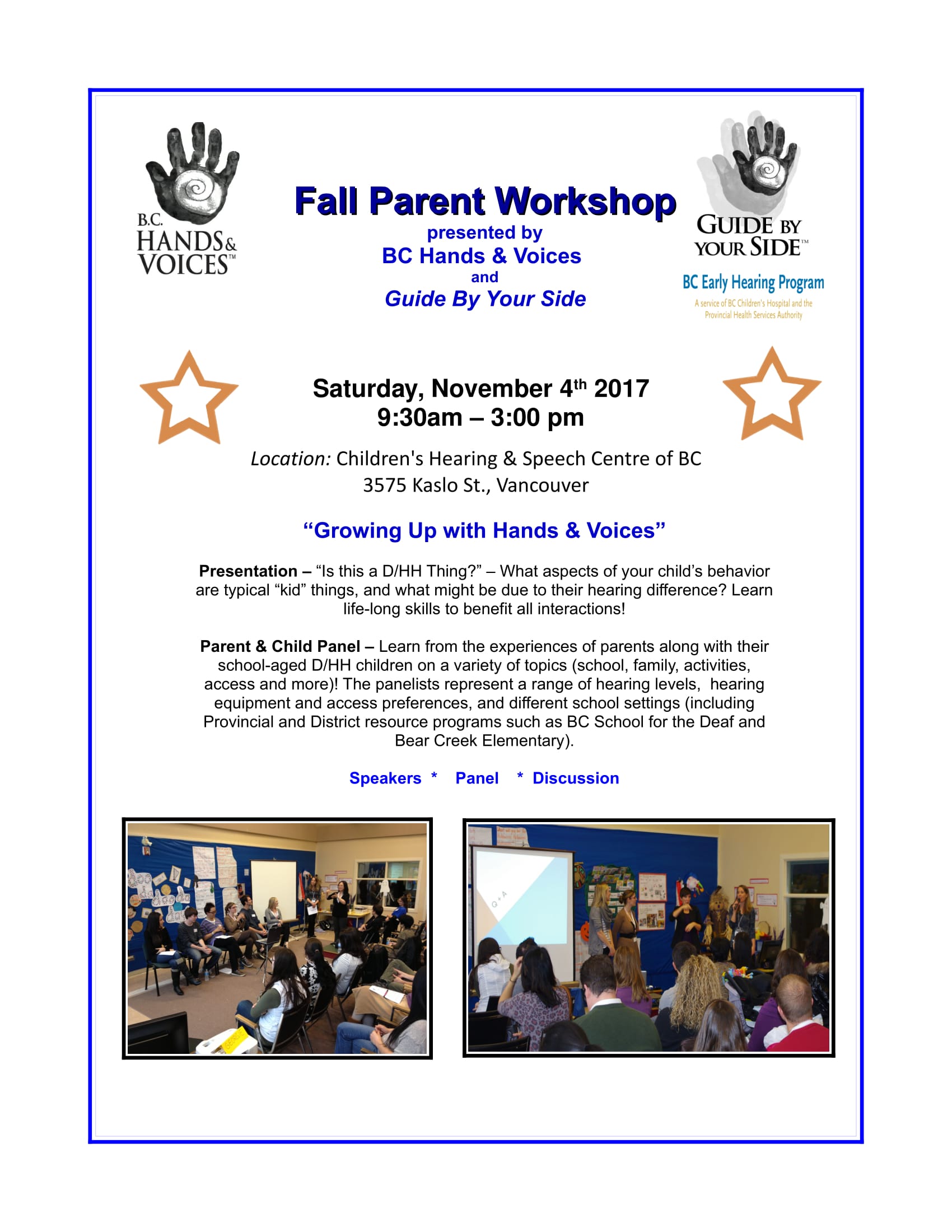
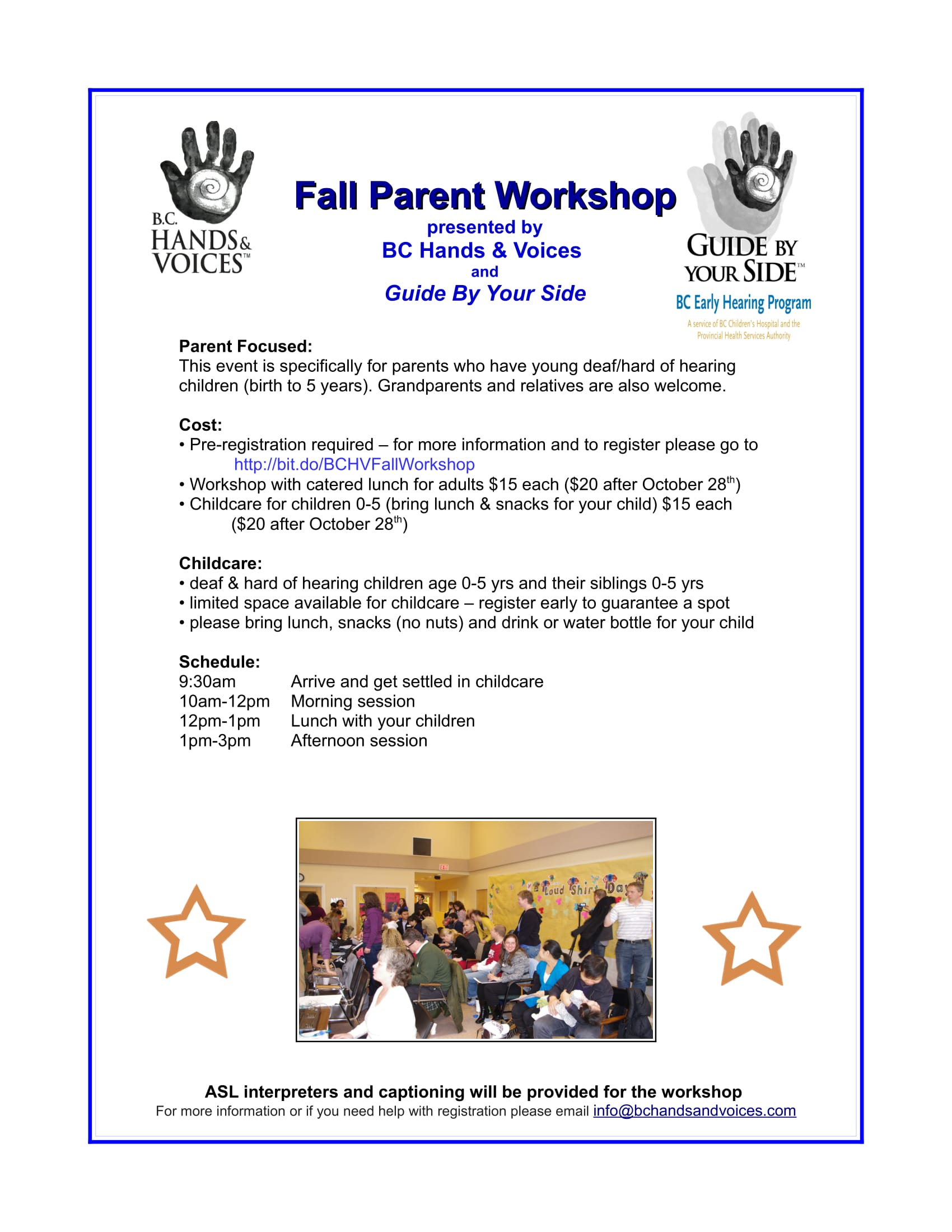
Event Title: Parent Workshop – Is “doing fine” good enough? Fostering Emotional Well-being in our DHH kids.

Hosts: BC Hands & Voices, Guide By Your Side, CHHA BC Parents’ Branch, & Family Network for Deaf Children

Description: Two of our favourite professionals, Janet Jamieson & Kristen Pranzl will help us explore strategies for developing and maintaining emotional well-being in our children who are deaf/hard of hearing. The workshop will include small group discussion, with opportunity to share your stories and questions, and connect with other parents of DHH children from 0-18 years of age. Captioning and ASL interpreting provided.

Childcare programs will be provided. Cost is $10 per person (adults and kids) lunch included.

Date: Saturday, October 17th

Location: NOTE change: Burnaby South Secondary – BC School for the Deaf
5455 Rumble Street, Burnaby BC

Link: Register @ www.chhaparents.com

11230139_10153591455345903_3195954151100471413_o

12006516_10153591455440903_6553569561843564466_o

Posted in Events | Comments Off on Parent Workshop – Is “doing fine” good enough? Fostering Emotional Well-Being in our DHH Kids

Dennis’ Story

My name is Shannon and our son’s name is Dennis. We are from the aboriginal community of Bella Bella(Heiltsuk), in the North Central Coast of British Columbia. You can reach us, 300 kilometres northwest of Vancouver, by air or ferry.

I have lived all my life in this community of 1300 people. We have many services to support our population including a community school that runs from nursery to Grade 12, general grocery store, hospital and health centre, social development centre, community hall, daycare, seniors building, and youth centre. However, our community hospital does not deliver babies; mothers leave the village to await the birth of their babies.

And so, Dennis’ journey began in Surrey Memorial Hospital, where he was born at 34 weeks on June 2nd, 2008. When Dennis was 2 days old he had a newborn hearing screening test, which he did not pass. Further testing by an audiologist confirmed that Dennis has a severe to profound unilateral hearing loss in his left ear.

2015-08-13 20.11.28_resized

We didn’t know what to think at the time. It was the beginning of a grieving process for us, for sure. At the forefront of our minds was for Dennis to gain weight, and for us to return home. It wasn’t easy being in a city we barely knew. Although it gave us a bit of time to think over what we had been told, we didn’t take it all in. All we knew was that we had our baby, and that we wanted to take him home and introduce him to our families.

The information mailed to us was really helpful but I didn’t connect with early intervention services right away.When Dennis was eight months or so, I started to explore outreach services. After speaking with A Guide By Your Side parent, Irealized the value of the help and care I could get over the phone or by emails. Even though I lived in such a remote community, I learnt that I wasn’t alone. Outreach services from a centre specializing in services for children who are deaf / hard of hearing observed and assessed Dennis, and gave us tools to help him develop his speech, language and communication. I started to see the big difference that this support could make as we dealt with Dennis’ hearing loss. From then on, I used it as much as I could, and I learnt a lot over time. Even today, we continue to practice a lot of the communication tools we learned through early intervention services.

One of the things I did was to purposely put Dennis in preschool, so he had the opportunity to interact with other kids his age, as well as his broader community. I spoke to him in detail all the time, and we read to him a lot. At the same time, we allowed him to be independent. This wasn’t always easy, as our families wanted to do a lot of things for him. We had to let them know what his needs were, but also that he had to learn to do things for himself, and that this would benefit him as he grew.

When he started Kindergarten, a sound field FM system was set up in the classroom. It was a learning curve for the teachers, but they understand the system now and it works well. He also receives some one on one support within the classroom from an aide. These services help to keep him engaged in the classroom, and Dennis is doing very well at school. We’re also very fortunate to have a Speech and Language program in our community that Dennis attends twice a week. Dennis’ communication level has really improved, and he’s currently working on some of the softer sounds like ‘s’,’ch’, and ‘th’.

My job involves advocacy around our community. This really helped me become an advocate for my son. I tell Dennis’s story to each person who works with him. I believe that advocating for Dennis benefits not only him, but everyone in our small community. Dennis is also becoming his own advocate; as well as being a very good observer, he’s very vocal.  

The past few years have been a challenge, but I was determined to make it work. Today, I still encounter struggles but the positive outcomes for Dennis make it all worthwhile. For example, our remote location can make visits to the Ear, Nose & Throat specialists at BC Children’s Hospital a challenge. In Dennis’s earlier years, we would travel down there for annual appointments. These have been valuable opportunities for us to get information and updates on Dennis’ so it was important for us to overcome the hurdle of distance. We have been able to get some travel expenses for Dennis and one escorting adult through the First Nation Health Authority. We choose to make these family trips though, so we save to make this possible. Taking the ferry to Vancouver Island, and driving from there has made for fun family trips.

Over this time, I’ve gained a greater awareness of what is needed to raise a child who is hard of hearing. Much of this is due to the outreach services and the programs that we have been able to access. Today, I am proud to be a Guide By Your Side Parent Guide. I am happy to be able to offer my support and share my experience with other families who have children that are deaf or hard of hearing. I find that being aboriginal and helping families not only guides them, but helps me to grow as a parent too.
For more information on unilateral hearing loss, please go to the BC Early Hearing Program website at: http://www.phsa.ca/our-services/programs-services/bc-early-hearing-program/understanding-hearing-loss/about-hearing-loss

For additional resources tailored particularly for Aboriginal families, please go to the BC Early Hearing Program website at: http://www.phsa.ca/our-services/programs-services/bc-early-hearing-program/support-services/resources-for-aboriginal-families

Posted in Articles, Families to Families, Unilateral Hearing | Comments Off on Dennis’ Story

3rd Annual Family Fun Picnic

The saying ‘third time lucky’ rang true for the 3rd annual Fun Family Day Picnic – for the first time, it was bathed in glorious sunshine instead of rain! The sun brought out 200 people on June 20th, 2015 to this event for deaf/hard of hearing children, their siblings and parents, and children with their Deaf/hard of hearing parents (CODA).

It was held at Provincial Deaf and Hard of Hearing Services Victory Hill Residence in Burnaby, BC. What a fantastic site to host the event. It’s internal courtyard provides a traffic-free safe haven for our children to run around. Parents can relax knowing that their little ones are entertained, and are free to connect with other families. This year, the shady picnic spots provided by the tree canopy were much appreciated. A group of families with babes in arms settled under the boughs of the biggest tree to enjoy one another’s company. The pot luck was a great addition to the hot dogs that were laid on, and the iced tea at the tea & coffee station was a popular choice on this hot day.

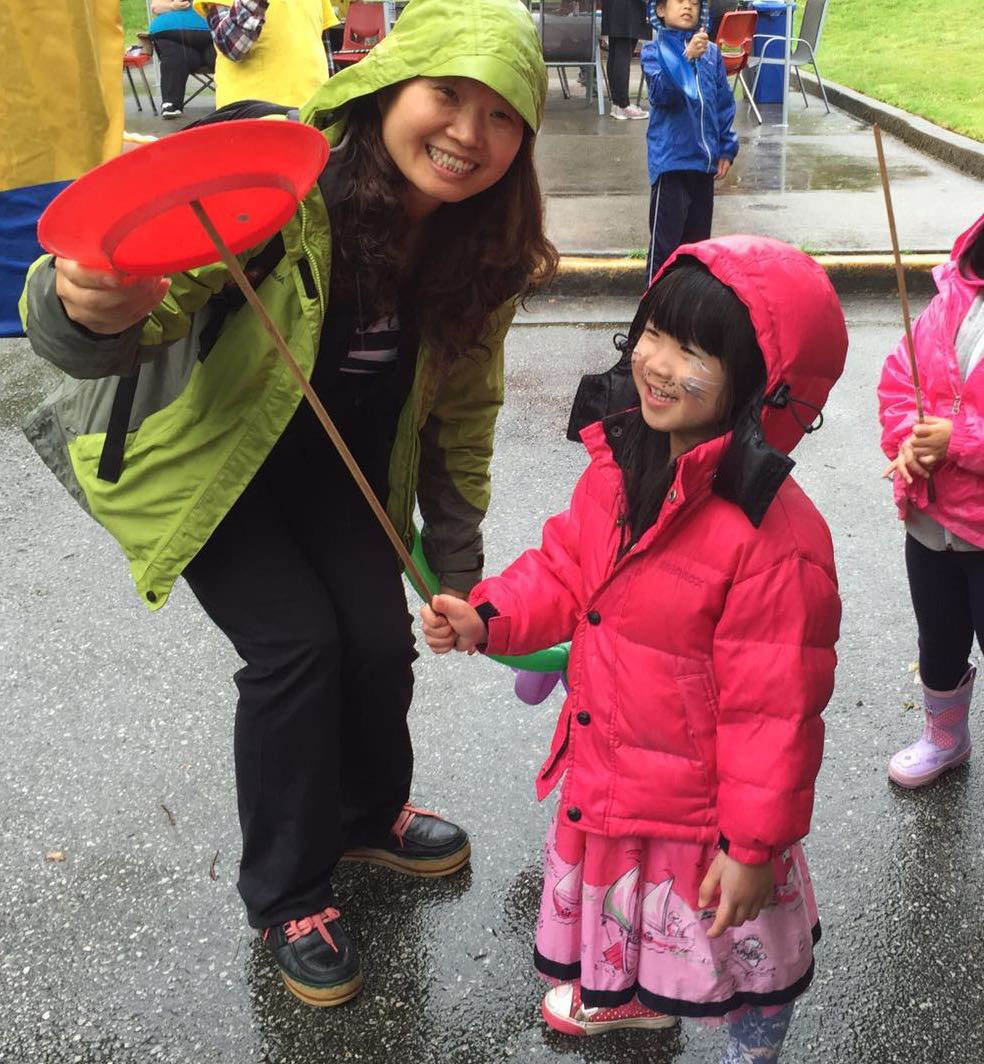
The calibre of the entertainers was impressive. I’ve never seen such amazing balloon creations and bedazzling facepaints and airbrush tattoos – thank you A-Star Art Parlour! Eileen Edgar the clown brought a smile to all the children, and the skills of the Vancouver Circus School were impressive, as was their patience as they supported children and adults alike to try the acts for themselves. Let me tell you, plate spinning is a lot harder than it looks!

Facepaint to dazzle the youngest guests!

Facepaint to dazzle the youngest guests!

As well as giving families the chance to mingle with one another, a highlight of the event for me was the opportunity to connect with youth/young adults who are deaf or hard of hearing. The Deaf Youth Today (DYT) staff really helped the event run smoothly right from the get-go, directing families to parking spots and towards the event entrance. During the picnic, they kept the momentum with lots of fun games. The water balloons were a big success. I must admit, when I first heard about this activity I thought it an odd choice for this group of children, many of whom wore water-sensitive hearing technology! The DYT staff opened my eyes, and shifted my perspective. It was a hands-on way to demonstrate to families that our children can fully participate in these activites. It was great to see so many role models for our children. Jesse Kazemir’s fiddle playing was awe inspiring, and a reminder to us parents that our deaf/hard-of hearing children can reach for the stars.

The event was jointly hosted by BC Hands and Voices (BC H&V)/Guide By Your Side Program (GBYS), BC Early Hearing Program (BCEHP), Canadian Hard of Hearing Association of B.C. Parents’ Branch (CHHA – BC Parents’ Branch), Family & Community Services (FCS), and Family Network for Deaf Children (FNDC)/ Deaf Youth Today (DYT). For a description of each of the sponsoring organizations, please follow this link: http://www.chhaparents.com/picnic-sponsors.php). For more information, to sign up to receive emails and newsletters, or to find out how you can get involved, you can check out their individual websites:

www.bchandsandvoices.com
www.phsa.ca/our-services/programs-services/bc-early-hearing-program
www.chhaparents.com
www.fndc.ca
http://www.mcf.gov.bc.ca/pdhhs/community_services.htm

Last but not least, many thanks are extended to the generosity of the board members of these hosting organizations and the many volunteers who all contributed to the great success of the day.

Posted in Events, Families to Families | Comments Off on 3rd Annual Family Fun Picnic

Lost & Found

Lost and Found
By Anja Rosenke, Richmond, BC

As we drove by a park in Vancouver recently, my mother reminded me of a story I had long since forgotten. The tale of the missing cochlear implants. How could I forget? Maybe I had blocked it out of my mind.

Lost & Found

Our son was about 2 ½ years old at the time, maybe 3, and we had come to the park with my friend and her kids on a beautiful sunny day, ready for some play time and a picnic. As we set up the picnic blankets, I followed my friend’s lead and let my kids head off with the others to play on the playground. I remember saying to myself, ‘Relax, Anja, let him go explore.’ So I allowed myself a good catch-up session with my friend as the kids went off.

While I wouldn’t call myself an obsessive or helicopter parent, I did tend to keep quite close watch over our son’s cochlear implants (CIs) back then. He was a toddler who tumbled as much as he toddled, he had a significant language delay, and was still getting used to wearing cochlear implants. As parents, we still managed his hearing equipment for the most part, and were very conscious of how expensive and important the gear on his head was. In fact, on most outings, I repeatedly looked or felt for that familiar magnet and cable the whole time we were out. Even though we secured his CIs with ear molds, and later two-sided wig tape, I had developed my own sort of nervous habit of constantly checking them.

The kids played for quite a while at this great playground, which has a climbing structure and swings, and is bordered by a nature path through some trees. Eventually they made their way back to us for snacks and drinks. My son trundled back as well – all smiles, not a shadow of concern on his cherub-like face. He set about happily shoving fistfuls of Goldfish crackers in his mouth, and amidst the pleasant chatter and noise, it dawned on me that my son was not responding when spoken to. Wait, where were his CIs? Panic struck – both of them were gone.

Because I didn’t want to interrupt everyone’s lunch, and we were trying to teach our son to become responsible for his implants, I started motioning to him, ‘Where are they?’ Pointing at his ears and putting my hands in the air questioningly, I was met with a blank expression and he went back to his snack, unphased. Truth is, he didn’t mind not hearing sometimes. And at the park, there was a lot of wind and background noise to contend with, so who could blame him. After a quick scan of the playground near our picnic blankets, I realized that this was not going to be a quick recovery. So we left our picnic to the ants and assembled our search party. The park suddenly looked expansive.

As we started to spread out and look – the four girls, my son, my friend and I – I realized that I couldn’t even retrace his steps because he had gone off with the older girls earlier. The one time I wasn’t paying attention! And just as despair was setting in, and I was simultaneously cursing myself for “letting go”, and calculating my chances for getting a loaner CI if I called our audiologist right away, my daughter called out, ‘Found ‘em!’ She was standing by the swing sets, and found them where my son had left them on the wooden barrier at the edge of the gravel. At least it was somewhat of a safe spot to set them down!

With relief, I thought to myself, ‘Ok, crisis averted, but how can I turn this into a teaching moment?’ At that age, my son had very little language because of the late identification of his hearing loss, so I had to keep things simple. Even though our goal for our son was a listening and spoken language outcome (which meant maximizing the time that he wore his CIs), we also strongly believed that he should be able to take breaks from hearing sometimes. We wanted to help him develop a sense of awareness in determining when he needed a ‘hearing break’, and the skill to tell us. Simply leaving them by the swing sets was not ok! So I tried to communicate this with simple language and gestures, and at home, I followed up by role-playing the situation again with his stuffies.

Self-determination is a skill development that can begin at a very young age. Creating an encouraging and supportive environment at home promoted active involvement and choice making, leading to successful transitions into school (Grolnick et al., 2009).

Did it work? I’m not sure it did that particular day, but I’d like to think that it was part of the learning process that has led my son to become very responsible about his hearing technology now. Nowadays he tells us when a battery dies or his CI stops functioning. He lets us know if it’s too windy or noisy for him, or if he’s not ready to put his CIs on first thing in the morning. As parents we continue to encourage this kind of self-advocacy, and remind him to speak up about what he needs, and teach him how to keep his CIs safe.

Parents’ promotion of choicefulness has been shown to be a strong predictor of children’s well-being, adherence to care and academic functioning (Grolnick, 2003; Grolnick, Ryan & Deci, 1991)

I am sure many families have had similar heart-stopping experiences with their child’s hearing equipment like our day in the park. The vast majority of children with hearing loss are born into families who have no prior history of hearing loss. As parents, we do our best to make good choices for our deaf or hard of hearing children. Because so much is at stake, parents tend to take charge right from the outset, and act as the main spokespeople for their child with the many professionals that support them. Family-centered support too is understandably directed at the parents, yet the benefits of including the child in conversations and choices surrounding his or her hearing loss, starting from an early age, are great.

While I could never imagine my son abandoning his CIs at the playground these days, I am mindful of continuing to encourage our son to participate in many aspects of his hearing loss, as is appropriate for his age, both at home and at school. We believe that including him in these conversations will empower him. Throughout his life, he may have opinions and ideas about his hearing loss that differ from our own as parents. Ultimately we want our son to become independent and competent, and feel successful with regards to his hearing loss and hearing equipment – whatever those choices are. And if we’ve done our job right then in the future, should he lose a CI while body surfing at a rock concert, he will know what to do.

References:
Grolnick, W. S. (2009). The role of parents in facilitating autonomous self-regulation for education. Theory and Research in Education, vol 7(2) 164–173.

Grolnick, W. S. (2003). The psychology of parental control: How well-meant parenting backfires. Mahwah, NJ: Erlbaum.

Grolnick, W. S., Ryan, R. M., & Deci, E. L. (1991). The inner resources for school performance: Motivational mediators of children’s perceptions of their parents. Journal of Educational Psychology, vol 53, 508-517.


Posted in Articles, Families to Families, Technology | Comments Off on Lost & Found
    Sign Up for Our eNewsletter!
  • H&V Mission (ASL)

  • Guide By Your Side Program (ASL)

  • Diversity, Equity & Inclusion

    We at H&V are looking within ourselves and within the organization to do better in supporting Black lives Matter. Learn more HERE.

  • Upcoming Events

  • Recent Posts

  • Categories